

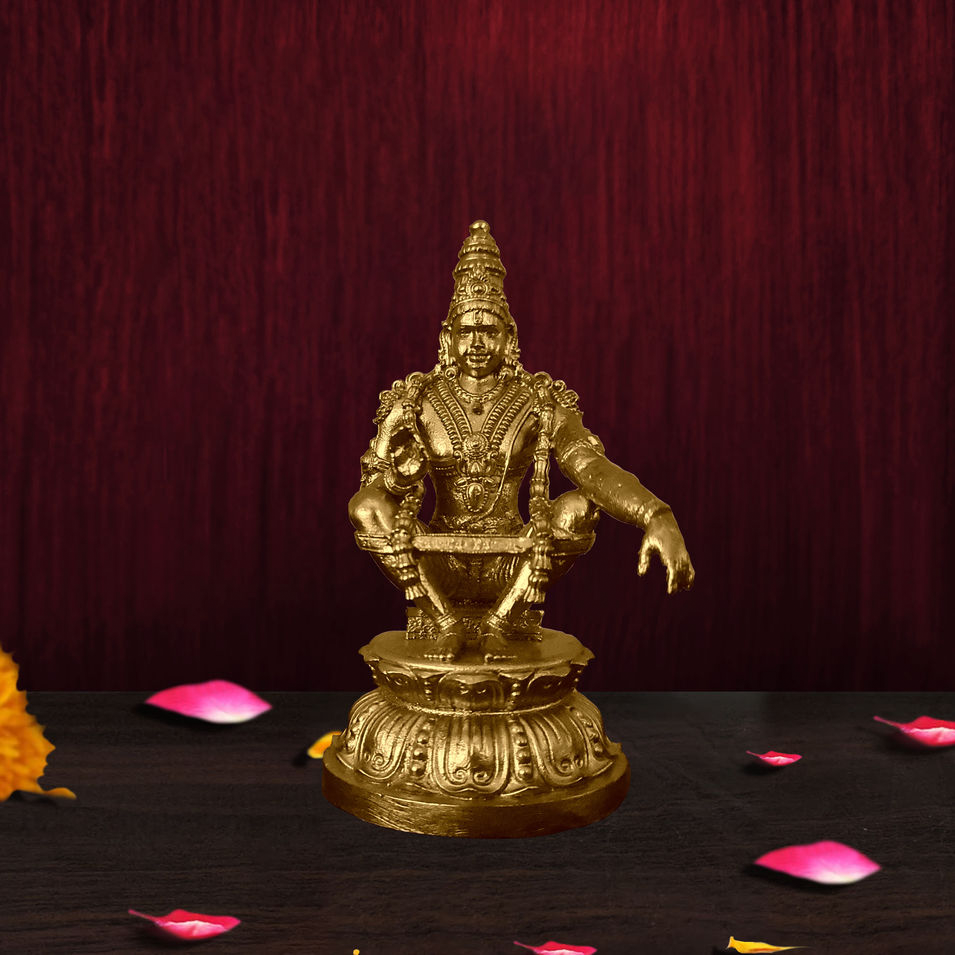
Sabarimalai Ayyappan Swamy, revered as Hariharaputra, the son of Lord Shiva and Lord Vishnu, is the celibate yogi and protector of dharma enshrined in the forested hills of Sabarimala in Kerala, and devotees welcome him into their homes through a brass Ayyappan idol placed in the pooja room. Known to millions as Manikandan, Dharma Sastha and Ayyappa, he draws pilgrims of every background who climb his sacred hill after weeks of strict discipline.
His story weaves together a royal foundling, a demoness with a boon, a tigress's milk, a Muslim warrior friend and eighteen sacred steps. Here on Idol Brass, we explore the story, symbolism and significance of Sabarimalai Ayyappan Swamy, the Lord who unites Shaivism and Vaishnavism in a single, compassionate form.
Who Is Sabarimalai Ayyappan Swamy?
Hariharaputra, Son of Shiva and Vishnu
The name Hariharaputra means "son of Hari and Hara". Ayyappan is believed to have been born from the divine union of Shiva and Vishnu in his enchanting form of Mohini. This shared parentage makes him a bridge between the two great traditions of devotion.
Manikandan and His Many Names
He is called Manikandan, "the one with a bell around his neck", after the golden bell found on him as an infant. He is also worshipped as Dharma Sastha, Sastha, Ayyappa and Bhutanatha. In Kerala and across South India, devotees affectionately address him simply as "Swami".
Ayyappan in the Sastha Tradition
Ayyappan is regarded as the form of Sastha who came to earth to protect dharma. He appears in Kerala's temple traditions as a guardian deity, and Sabarimala is his most celebrated abode, drawing devotees from across India and abroad.
Iconography and Symbolism of Ayyappan
The Yogic Posture
At Sabarimala, Ayyappan is shown seated in a yogic posture, with his knees drawn upward and bound by a yoga band, his hands held in a mudra of knowledge and assurance. This posture expresses inner stillness, self-control and the calm strength of a deity who has mastered the senses.
The Golden Bell
The bell on his neck recalls the moment he was found on the banks of the Pampa River. It stands for the divine child who came into the world with a purpose, and it gives him the name Manikandan.
The Tiger and the Bow
Ayyappan is often shown riding a tiger and holding a bow and arrow, symbols of fearless protection and of dharma defended with courage. The tiger comes from a famous episode in his youth, described below.
The Celibate Lord
Ayyappan is worshipped as a Naishthika Brahmachari, a lifelong celibate. This is why the pilgrimage to his shrine is built around purity, restraint and simplicity of life.
The Legend Behind Sabarimala: The Birth of Ayyappan
Mahishi and Her Boon
The demoness Mahishi, sister of Mahishasura, obtained a boon that she could be defeated only by a child born of both Shiva and Vishnu. Believing this impossible, she began to terrorise the gods and the world.
Mohini and Shiva
To fulfil the prophecy, Vishnu took the form of Mohini, and from her union with Shiva a divine child was born. The child was to end Mahishi's tyranny and restore balance.
The Foundling of Pandalam
According to tradition, the infant was left on the banks of the Pampa, where King Rajasekhara of Pandalam found him with a golden bell around his neck. The childless king took him home and named him Manikandan.
The Boyhood of Manikandan and the Queen's Plot
A Prince Beyond Ordinary Measure
Manikandan grew up as a prince, excelling in scriptures and martial skills. His teacher soon recognised his divinity, and his fame spread across the kingdom.
The Queen's Jealousy
After the queen gave birth to a son of her own, a scheming minister stirred her fears that Manikandan would take the throne. She feigned a grave illness, and it was said that only tigress's milk could cure her.
The Return with the Tigers
Manikandan went into the forest to fetch the milk and returned riding a tigress, followed by her pack. The astonished court realised he was no ordinary boy, and the queen begged forgiveness. Manikandan, having fulfilled his purpose, chose to leave the palace.
The Defeat of Mahishi and the Vow of Malikappurathamma
The Battle with Mahishi
On his path to fulfilling his destiny, Manikandan confronted Mahishi and defeated her, according to tradition. This victory brought peace to the world and ended her reign of terror.
Lila and the Promise
From Mahishi's body emerged a beautiful woman named Lila, freed from a curse. She asked to marry him, but Ayyappan explained that he was a celibate lord. He promised that when the number of first-time pilgrims, the Kanni Ayyappans, ceases to visit Sabarimala, he would marry her. She is worshipped as Malikappurathamma at a shrine near the main temple.
Vavar, the Trusted Friend
Ayyappan's companion Vavar, a Muslim warrior, is remembered with great honour. Pilgrims traditionally visit his shrine at Erumeli and at Sabarimala, a lasting symbol of harmony between faiths.
Ayyappan's Ascent to Sabarimala
The King's Realisation
King Rajasekhara finally understood who his son was and begged for his guidance. Ayyappan asked that a temple be built for him at Sabarimala and showed the location by shooting an arrow.
Merging with the Sanctum
Tradition says that Ayyappan then entered the sanctum, becoming one with the idol. Sabarimala became his eternal abode, where he grants blessings to all who arrive with a clean mind and sincere faith.
The Sabarimala Temple and the Sacred Pilgrimage
The Temple in the Western Ghats
The Sabarimala Temple stands on a hilltop in the Western Ghats in Pathanamthitta district, Kerala, amid dense forest. Pilgrims usually begin their trek from the Pampa River, offering prayers along the way.
The Eighteen Sacred Steps
The Pathinettam Padi, or eighteen golden steps, lead to the sanctum and are climbed only by pilgrims who carry the irumudi, the two-compartment bundle of offerings on their heads. Tradition offers many meanings for the eighteen steps, including the senses, the qualities of nature, knowledge and ignorance, all left behind on the climb.
Makara Jyothi and Makaravilakku
On Makara Sankranti, a divine light known as the Makara Jyothi appears on the Ponnambalamedu hill, and the lamp ceremony of Makaravilakku is performed. Thousands of devotees gather to witness the sacred light and to chant Ayyappan's name.
The Thiruvabharanam Procession
Before Makara Sankranti, the sacred jewels of the deity are carried in procession from Pandalam to Sabarimala. This ritual connects the temple with the royal family that raised the young Manikandan.
Harivarasanam, the Night Lullaby
At the close of each day, the temple resounds with the Harivarasanam, a lullaby sung as the Lord is put to rest. It is one of the most beloved devotional songs in South India.
The 41-Day Vratham and Its Discipline
The Mala and the Simple Life
Pilgrims take a 41-day vow before the journey. They wear a rudraksha or tulsi mala, dress in black or blue, abstain from meat and intoxicants, sleep simply and avoid anger and harsh speech.
One Chant for All
During this period, devotees address each other as "Swami" and chant "Swamiye Saranam Ayyappa". Differences of wealth, caste and status fade, as everyone is equal before the Lord.
Spiritual Significance of Sabarimalai Ayyappan Swamy
Harmony of Shiva and Vishnu
As the son of Shiva and Vishnu, Ayyappan represents unity beyond sectarian boundaries. Devotees from both traditions find in him a common refuge.
Equality and Humility
The words "Tat Tvam Asi" are inscribed at the temple, reminding pilgrims that the divine dwells within every being. Together with the friendship of Vavar, this message makes Sabarimala one of India's most inclusive pilgrimages.
Discipline and Self-Mastery
The 41-day vratham teaches restraint, humility and detachment. Many devotees say the true pilgrimage is the transformation that takes place within.
Protection and Dharma
Ayyappan is worshipped as a protector, and devotees pray to him for courage, safe journeys, freedom from fear and the victory of righteousness.
Why Is Ayyappan Different from Other Deity Forms?
Hariharaputra: Unlike most deities, he is the son of both Shiva and Vishnu, uniting two traditions in one form.
Compared with Ganesha: Ganesha is worshipped as the remover of obstacles at the start of every undertaking, while Ayyappan is the disciplined protector approached after long penance and vows.
Compared with Murugan: Murugan is the young commander of the divine army who is married to Valli and Deivayanai, whereas Ayyappan is worshipped as a lifelong celibate yogi.
A pilgrimage of discipline: The 41-day vratham, the irumudi and the eighteen steps make the journey to Sabarimala as important as the darshan itself.
A shrine of harmony: The bond with Vavar and the message of Tat Tvam Asi give Sabarimala its unique spirit of inclusion.
Conclusion
Sabarimalai Ayyappan Swamy is the Lord who joins Shiva and Vishnu, the yogi who guards dharma, and the friend who welcomes every pilgrim as "Swami". His story of Mahishi's defeat, Vavar's friendship and the eighteen sacred steps continues to inspire devotion, humility and self-discipline. For devotees across Kerala, Tamil Nadu and beyond, his blessings bring courage, protection and inner peace.
Comments
Log in or sign up to join the conversation.