

I believe Berkshire Hathaway (BRK-B) is an attractive investment now, especially in taxable accounts because it pays no dividends and is "tax friendly".
But in IRA retirement accounts, a good alternative may be to purchase the Boulder Growth and Income Fund (BIF) because of its large discount to NAV and large holdings in Berkshire Hathaway stock and other solid blue chip stocks.
BIF- Five Year Discount History
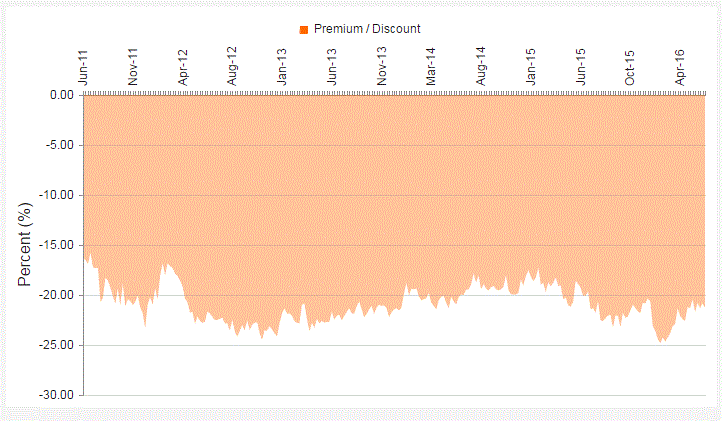
BIF now reports its NAV daily. As of June 20, 2016, the discount to NAV is -21.16%. Management has already taken some steps to reduce the discount to NAV, which at one point got as high as -25%:
- Completed the four way fund merger to reduce the expense ratio and improve trading liquidity. The expense ratio for 2015 was 1.48%. This is expected to drop further this year, since there will not be any merger related expenses this year.
- Implemented changes to the fund web site to provide clearer information about the fund.
- Moved from weekly to daily updates of NAV.
- Moved to monthly reporting of portfolio holdings.
- Introduced a monthly managed distribution plan in November 2015. The fund currently pays a $0.033 monthly distribution or about $0.40 a year.
The fund had 45 holdings as of the end of April, and the assets are highly concentrated with 68% of the portfolio in the top ten holdings. Here are the top ten BIF portfolio holdings as of April 30, 2016 taken from the fund web site.
Top 10 BIF Holdings (as of 4/30/2016)
|
Berkshire Hathaway, Class A |
22.11% |
|
|
Yum Brands, Inc. |
6.42% |
|
|
BRKB |
Berkshire Hathaway, Class B |
6.23% |
|
JP Morgan Chase & Co. |
5.73% |
|
|
Chevron Corp. |
5.73% |
|
|
Wells Fargo & Co. |
5.44% |
|
|
Wal-Mart Stores, Inc. |
4.83% |
|
|
Cisco Systems, Inc. |
4.42% |
|
|
Pfizer, Inc. |
3.48% |
|
|
Caterpillar, Inc. |
3.42% |
Why Has the Discount Historically Been So High?
1) Between 2008 through last year, BIF only paid income and required capital gains distributions annually. The lack of regular distributions made it unattractive to many retail investor. But In November, 2015, management resumed regular monthly distributions
2) The expense ratio has historically been high. But last year, after a 4-way fund merger, the management fee was cut to 1%.
3) Before the 4-way fund merger, there was very little trading liquidity. But over the past few months, the fund has been trading over $800,000 a day.
4) BIF is effectively controlled by one person - Stuart Horejsi. Trusts controlled by Horejsi own about 43% of the fund. But having a large controlling investor is not always bad. For example, Warren Buffett controls a large block of Berkshire Hathaway and Carl Icahn controls IEP, which both sell at a premium to book value. As long as Horejsi continues to institute policies friendly to minority shareholders, the BIF discount should continue narrowing.
Summary
I believe there is an excellent chance that BIF will see its discount to NAV narrow to the 15% range within the next few years, as more retail investors realize that it pays a steady 5% distribution, has reasonable fees and above average performance. There is also an outside possibility that management may decide to convert BIF into an open-end mutual fund. BIF has an excellent 10 year track record compared to its Large Value peers and could attract additional capital as an open-end fund.
Comments
Log in or sign up to join the conversation.