


A lot of (hopefully) quick hits today.
On Wednesday, I got a call and an email from the Blueprint Chesapeake Multi-Asset Trend ETF (TFPN). Similar to MFUT from Cambria that we looked at the other day, Jerry Parker is the brains behind the fund, and the point of differentiation of the strategy underlying both is that they use individual stocks as part of the mix.
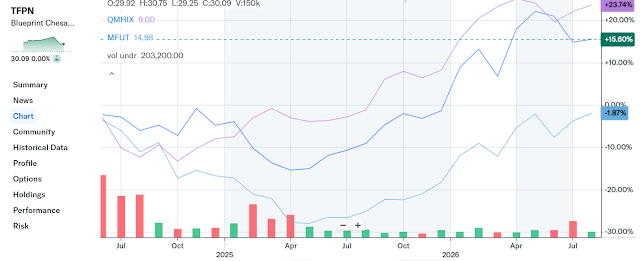
The returns are not identical; if you're curious, you can look at the two funds to try to figure out the differences. The website for TFPN has a lot of information, including this asset mix that excludes cash. Quick note: managed futures funds typically hold a lot of cash/T-bills to collateralize the futures positions.
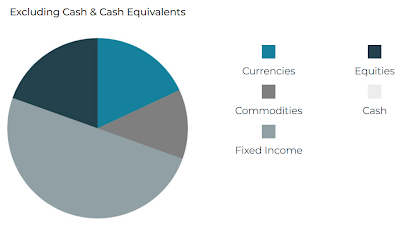
I read that as 50% fixed income, 20% each to equities and currencies, and 10% to commodities. It feels quadrant inspired or adjacent. I plugged those weightings in as follows.
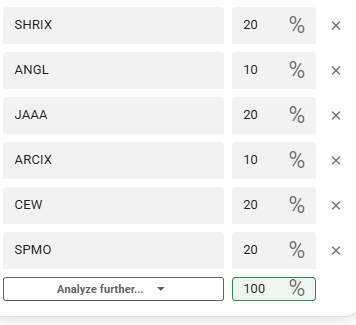
True to yesterday's post, it has 20% in unconstrained equity beta with SPMO. Commodities with ARCIX might offer some of the attributes of managed futures we talked about yesterday but just with commodities.
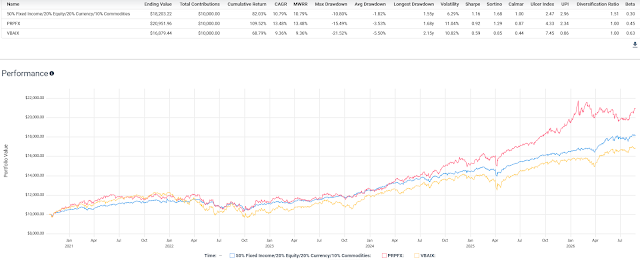
That mix offers a very smooth ride. With so little in equities, it might have trouble keeping up with the other two longer term, but CEW was the only fund I could come up with for currency, and it added almost nothing to the growth rate. Given more time, the FOXY ETF from Simplify might turn out to be a better mousetrap for this idea.
About a month ago we looked at the Dynamic Alpha Macro Fund (DYMIX). The fund is essentially 50% equities and 50% macro. For a macro fund, it has very few moving parts. A month ago, the macro positioning held gold, copper, and five-year treasuries. In that first post, we saw that it was struggling, and following up on yesterday's post, we did do a little attribution analysis. The decline in gold and, to a lesser extent, the decline in copper hurt the fund. One month later, the fund is long corn, sugar, and the yen in addition to gold, and it is short coffee, cattle, and the five-year treasury.
Fast forward a month, gold was up a lot, and corn was up 10%, which helped the fund lift 9% since that last post. I like the idea of 50% equities with 50% macro, but DYMIX might be more of a multi-asset fund than a macro fund. I'm not sure, but I am keeping tabs on it.
This is something I've been talking about for 20 years. Not so much an ETF, but figuring out how to invest in farmland and if that turns out to be an ETF, cool!
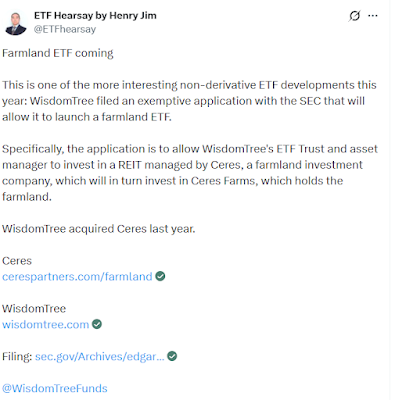
A long time ago, I went down this rabbit hole looking at some very small foreign stocks that owned plantations and the like. It was very difficult to get decent information, and just watching the stocks for a while, they were not investable. I will be very interested to see if it comes to market and what it actually will do. This is a very useful alt, but I have no idea at this point if this fund will be the answer. More to come.
Last one. ProShares has thrown its hat into the autocallable ring.
I sat in on a webinar which focused primarily on ACSP. A couple of high-level points: autocallable ETFs actually track more volatile versions of the reference indexes to get the yield up. ProShares also said repeatedly that autocallables are like complementary cousins to covered call ETFs. They didn't word it this way, but covered call funds sell....ahem...call options while autocallable strategies are better thought of as selling puts.
The presentation included "pre-inception" performance going back to 2010 and showed the year-by-year yields ranging from 14%-20%. They put up a chart comparing the S&P 500 to the higher vol index (autocall index) used for ACSP, and it showed going up less but with more volatility most of the time. In a few of the serious drawdowns, the autocall index actually went down less. If I understood correctly, the distributions are not in jeopardy until there is a 35% drawdown in their respective indexes. Admittedly, that won't happen very often, and if ACSP is anything like Calamos Autocall (CAIE), then there is a mechanism where distributions resume after some amount of recovery.
I submitted a couple of questions to better understand what the real risk is, but they were not answered. We are in a 4-5% world. Supposedly, ACSP will range from 14-20%; the website for the fund shows 18% currently, so there is risk there. The extra 14% is compensating for something, and I cannot figure out what that is. Taking that sort of risk is not necessarily bad, but I think taking that risk without understanding it is a bad idea.
JELM from Janus seems to be the lowest yielding of the autocallables at more like 9% (please leave a comment if you know otherwise). In a world of crazy high yielders, it can be easy to lose sight of 9% being a fantastic payout rate. The track record is nowhere long enough for me to use the fund at this point, but everything else being equal, 9% will be less risky than 20%.
And "pre-inception?" Really? I felt icky just typing that.



Comments
Log in or sign up to join the conversation.