

For numerous reasons which I will delineate, I believe the SPY has topped out at 213. The drop to 187 was only a precursor of a greater drop to somewhere between 140 and 160. This ultimately should create one of the best buying opportunities of the last several years - once it is over.
Here is why I think the market is set for a fall:
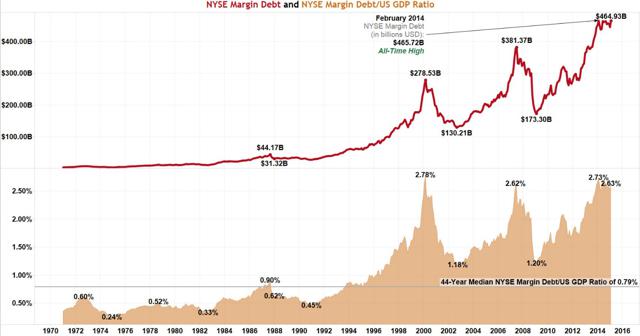
1 - The level of margin debt reached $464 billion, or 2.78% of the GDP, in April of this year. Levels this high have only happened two other times - once in Mar. 2000 (2.78%) and again in July 2007 (2.62%). In 2015, the S&P topped out in May 15 at 2,132. The margin debt topped out on April 2015. If past is prologue, the drop this time could be comparable to the two prior declines, or around 45%. In 2000, the S&P topped out in January 1 at 1,500. The margin debt topped out March 2000. The market drop was 45%. In 2007, the S&P topped out in July 4 at 1,526. The margin debt topped out July 2007. The market drop was 48%.
2 - A look at the levels of the advance-declines shows that although the indexes were all climbing fewer and fewer stocks were participating.
"Currently, Tom McClellan sees a number of bearish patterns warning that the big one is likely to hit Wall Street very soon, he reported. For one, the advance-decline line, which tracks the number of stocks participating in a trend, started declining nearly four months ago."
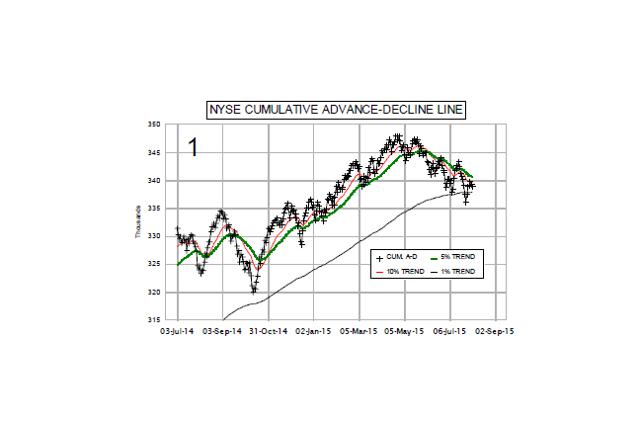
Tom McClellan sees ugly decline
3 - Quantitative Easing began as a policy by the Federal Reserve in August 2008. After a brief pause for the efforts to kick in, the S&P took off on a run with only several minor pauses. Each subsequent QE added more fuel to the fire, driving the market even higher. As QE drove interest rates lower and lower, the market went higher and higher. The fix was in - so to speak.
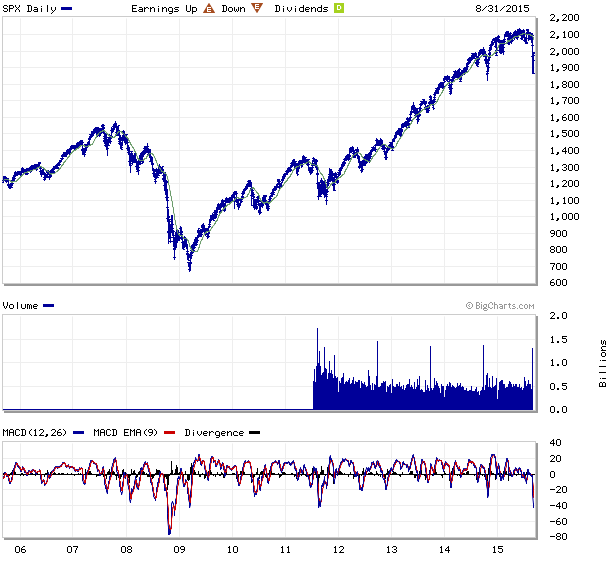
Courtesy of BigCharts.com
4 - The strength in the US dollar also provided fuel to the fire, as funds from all over the world came to the US seeking a safe haven. As the other economies all weakened, the US was just coming out of its recession. Problems in Brazil, Italy, Spain, Portugal, Russia and finally China created a panic mentality that poured money into the US markets. As many of the US's major stocks provided yields in excess of the US bond market, a disproportionate amount of the funds went into the stock market.
5 - Additionally, US companies with operations overseas (Apple (NASDAQ:AAPL), GE (NYSE:GE), etc., etc.) were holding vast sums of cash offshore so as not to have to pay taxes. Soon, as the interest rates came crashing down (thanks to QE1-4), these guys realized they could borrow money virtually for free (when collateralized by their cash) and buy back their own stock, thereby repatriating their cash without having to pay any taxes. The numbers total something approaching $2.4 trillion between 2003 and 2012 and much more since then. No wonder the market went up. (Corporate buybacks)
5 - Enormous capital gains have been sitting in all the portfolios after the 7-year QE market run. Any sense of impending loss will trigger enormous panic selling to protect those gains. The drop we saw the other day was just an example of how ferocious that selling can be. Hedge funds have exacerbated the volatility by being able to drop billions (if not trillions) in sales at a moment's notice.
6 - The carry trade for currency plays now stands at $9.0 trillion. Much of this money is in Emerging Market bonds. As these trades unwind due to currency implosions, the markets worldwide will be thrown into even more turmoil and volatility so of which will find its way back to the US. (Carry trade troubles)
7 - Louise Yamada - One of the best technical analysts around has just made a very negative call on the market. She sees the S&P dropping to 1,800 and then maybe 1,600. In round numbers, this is a 25%+ projected drop.
8 - As the downdraft builds, we will move into year end and tax selling that will drive prices even lower. Hedge funds are having a terrible year this year (after several very good years). This could create a pent-up amount of stock for sale if the market decline is as severe as projected. A major spike down cannot be ruled out.
All one has to do is look at SunEdison's (SUNE) chart to understand what hedge fund panic selling looks like. In 45 days, SUNE went from $35 to $8 before bottoming out and rebounding to $10.50. Between the high and the low, over $5 billion in shareholder value was wiped out. To get a sense of what this number means, SUNE's current market cap is only $3.5 billion.
SunEdison
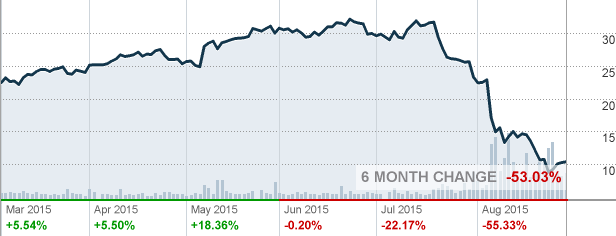
Courtesy of Google Finance
Conclusion
Margin debt is tapped out. And, advance-declines show that the broad market is not going up anymore and is probably set for a fall. And, QE has pretty much reached the end of its line - and its low interest rates have been the key driver of this market. And, overseas cash repatriation has sucked most of that money back home already. And, the excessive amount of money in leveraged hot trades - like hedge funds - will make the speed and depth of this drop even more extreme. And, the market has had a massive run with hardly a pullback - so fear of capital loss is now far greater than fear of missing out on future profits i.e. fear is much greater than greed. And, losses are mounting in overseas markets. And, the carry trade is imploding.
So where is the new money going to come from to drive the market higher? My answer is: I don't know. Like 2000 and 2008, I see that the vast amount of funds are already fully invested - plus margin leveraged to boot. Therefore, I think the market's most reasonable path is to decline until it finds a new equilibrium. Given the history of prior post margin peak collapses, that should mean 45% or more lower.
And Now - What To Buy
For the moment, I have been buying the SPDR S&P 500 Trust ETF (NYSEARCA:SPY) puts in the $200 area. I have used option expirations that run from Nov. 20, 2015, to Mar. 31, 2016. I believe the market drop will be rapid and fairly short. That being the case, I am concerned about the loss of capital. This put position cushions that situation. After we see how things play out, I will see whether these put positions should be rolled forward or lifted. If the market decline is of the dimensions that Louise Yamada sees, this will be a longer-term affair than just the next 6 months.

Comments
Log in or sign up to join the conversation.