

I spent some time in Copilot exploring the 75/50 portfolio which seeks to capture 75% of the market's upside and only 50% of the downside. It suggested the following to create 75/50;
55% Hedged Equity
25% Convexity (like managed futures)
20% Market Neutral
To build this idea, I used JHEQX for hedged equity, for managed futures I wanted higher volatility so I used QMHIX and for market neutral I went with MERFX.
The backtest is almost exactly on target.
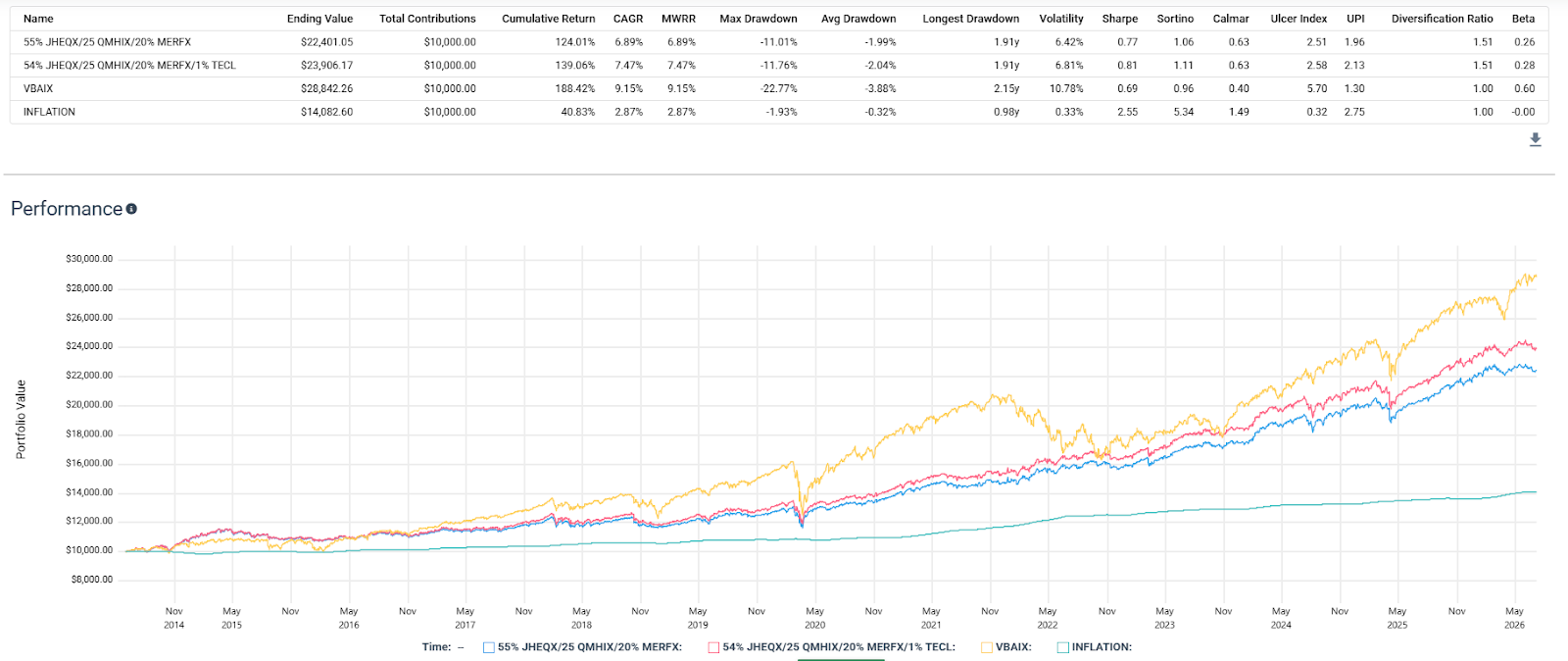
I typically say that over the longer term 75/50 works out for the better. For the entire backtest period available, that wasn't the case but if you look at different time periods you can see where that would have been the case and either way, it's been a much smoother ride. In Portfolio 2, I threw a 1% weight to TECL which is 3x technology. That pushes up the CAGR slightly more than it does the volatility which causes the Sharpe Ratio to improve very slightly.
For a little context to Portfolio 1, and 2 to a lesser extent, over the same period, throwing it all in AGG would have compounded at 1.86% with a volatility reading of 5.11%. AGG's standard deviation was actually quite a bit higher than either 75/50 combo.
Copilot thinks the mix of hedged equity, convexity and market neutral is durable going into the future because none of the three are new strategies. They've all been around for a while and endured many types of adverse market events.
I tried a slightly different version with lower vol AQMIX instead of QMHIX and cat bonds instead of merger arb and that improved the results very slightly.
In any real world application of something like this, I would want to carve up the three segments to use more than just three funds. To the extent that Copilot is right about this being durable, a 4% real return with such low volatility can probably work for someone who is ahead of where they need to be.


Comments
Log in or sign up to join the conversation.