


The Sovereign Wealth Fund of Norway is looking to reduce its exposure to US treasuries. Kenneth Crompton from National Australia Ban is quoted in that article as saying "they’re arguing that they already own enough government bonds to satisfy liquidity needs, and that a long-horizon investor should harvest a broader set of fixed income risk premia.” I like that quote, trying to harvest a broader set describes what we're trying to do here.
Pivot over to Barron's and this doozy of headline; The Death of the Safe Haven: How to Fix Your Bond Strategy as Yields Rise. Death is a strong word. The second sentence is unintentionally funny; "as interest rates rise, bonds are becoming a drag on investment portfolios." Becoming? A little later on, "a sizable allocation to a popular exchange-traded fund such as iShares Core U.S. Aggregate Bond (AGG) (ticker: AGG) or iShares 20+ Year Treasury Bond (TLT) may not do much to bolster a portfolio." Then it noted AGG being flat on the year and TLT down 2.36%.
Michael Cuggino who manages the Permanent Portfolio Mutual Fund (PRPFX) was cited in the article raising the point we've making here for a while about whether yields further out the curve provide adequate compensation for the risk and the volatility associated with duration. John Montgomery from Bridgeway Capital notes that investors think bonds are safe but they are not.
Andy Briggs from Plaza Advisory said he's taken 70/30 to 60% equities/22% fixed income/13% alts. He likes liquid alts, especially market neutral and macro strategies.
Something about that passage made me think about 30/30/40 where the 40 refers to alt exposure.
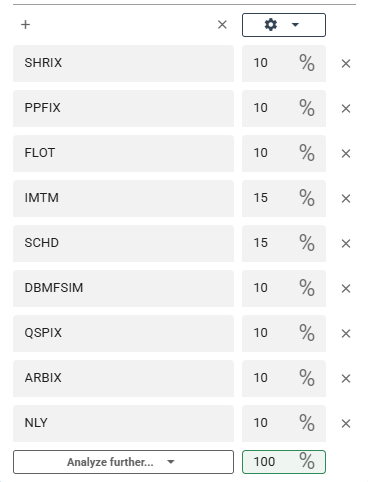
The first three are fixed income or fixed income substitutes, the next two split the equities evenly between foreign and domestic and then four alts that don't have overlapping risks. NLY is cheating a little bit but the number of times it does its own thing versus the rest of the world, it's arguably altish. Very volatile, the most volatile holding in the mix, but I think calling it alt-like is defensible. The portfolio has a trailing yield of 4.98%.
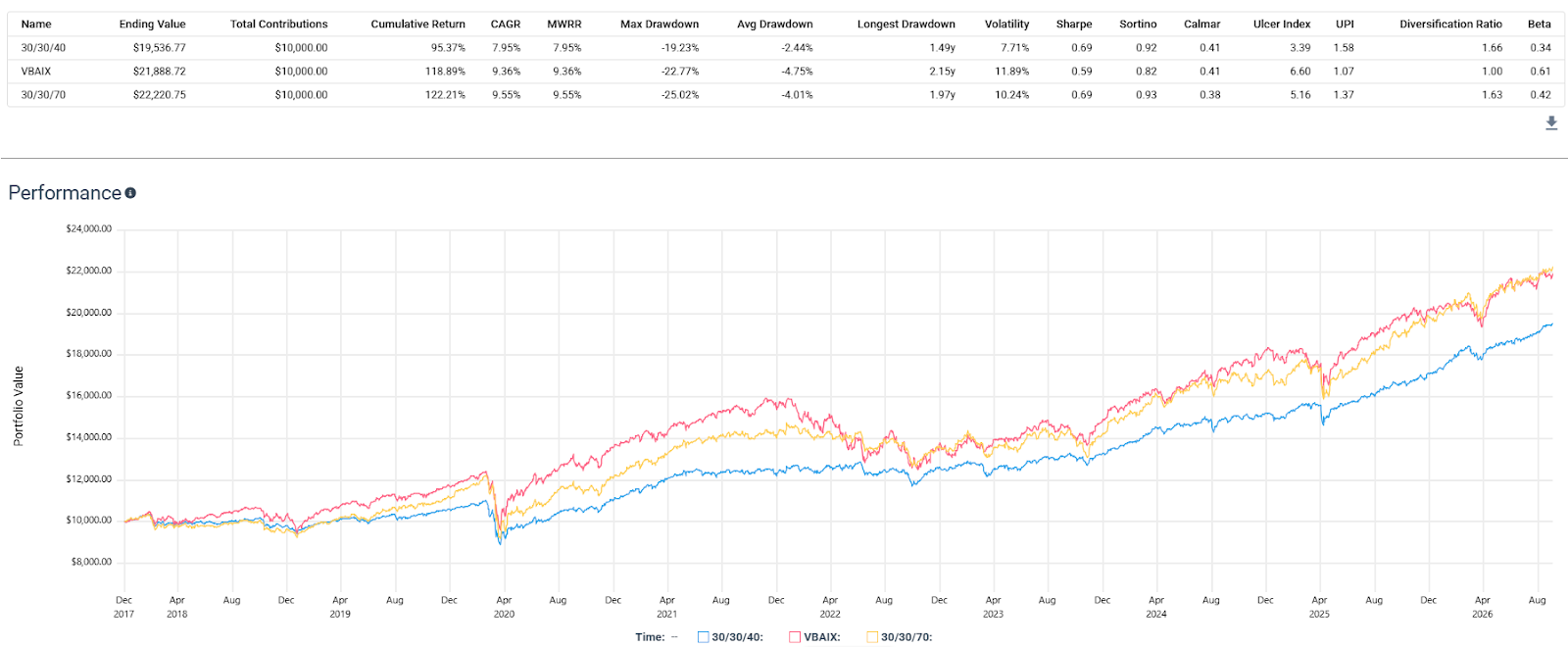
I was able to weave together funds with a decently long track record. Newer funds backtested with better results but I didn't feel confident about a 3 or 4 year look back being as reliable. Portfolio 3 is levered up. I swapped out the three fixed income funds and two equity funds for a 30% weight in PSLDX which is a PIMCO fund that owns 100% equities and 100% long bonds. I then put 17.5% each into the four alt funds.
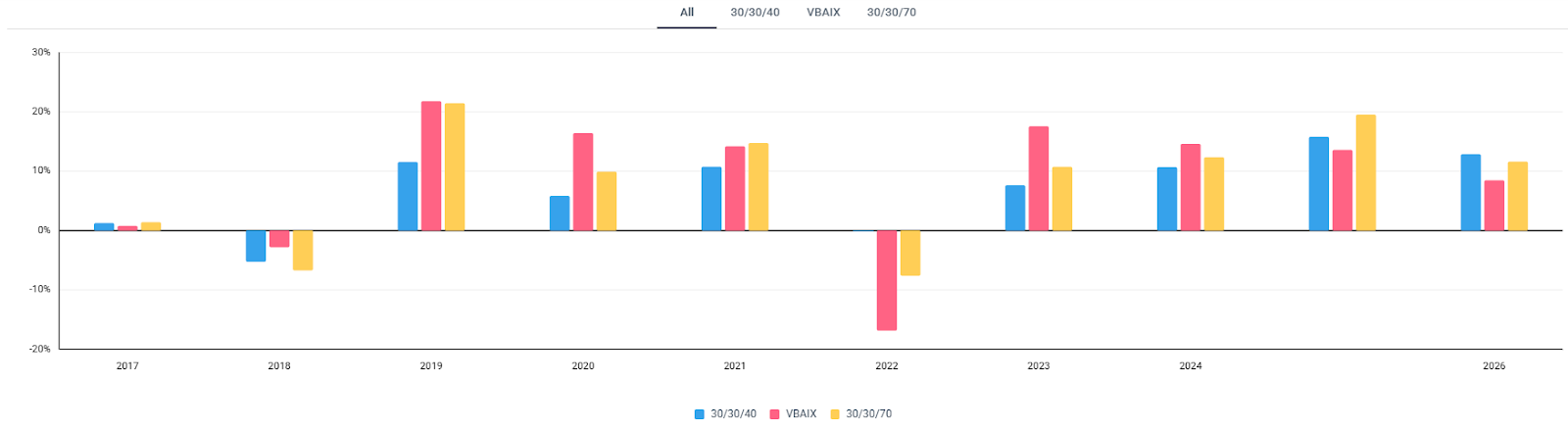
Despite the misery of long bonds, the 30% weighting to long bonds in Portfolio 3 wasn't problematic which is very interesting. Another point to consider is that looking back a portfolio would have generally been better off with domestic equities only. In Portfolio 1, only has half its equity sleeve in domestic and it has a lot less equity than VBAIX. IMTM lagged SPY by 500 basis points compounded and SCHD lagged SPY by 230 basis points compounded. PSLDX' 30% weight to SPY is a lot of basis points that Portfolio 1 didn't get, looking back.
A quick word about PSLDX. It is a very old mutual fund. In the period we studied back to late 2017, the total return of that fund compounded at 12.42%. The price only growth rate was negative 3.94%. If you look at the dividend payout history on Yahoo Finance you will see that some of the distributions have been enormous. You can dig into that if you're interested but I am thinking it might be paying out some very old capital gains but I don't know. In an IRA or Roth those distributions can just be reinvested and that's the end of it but for taxable accounts, tax will be owed whether the distributions are reinvested or not.
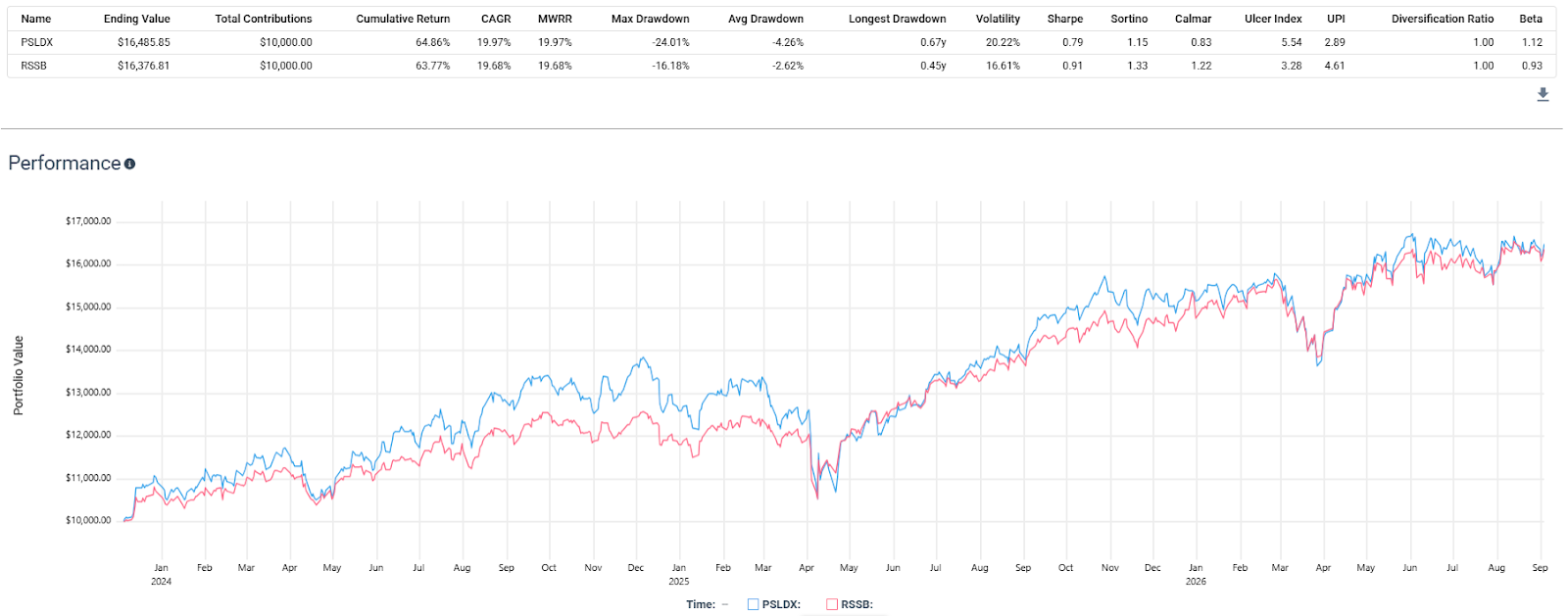
For anyone actually considering this, RSSB from ReturnStacked does something similar but the duration is a little shorter.
Coincidental to what we just looked at, Jason Zweig wrote about levered ETFs. Corey Hoffstein from ReturnStacked retweeted it noting that there is a difference between leverage for magnifying returns versus leverage for adding diversification and then Cliff Asness retweeted Corey agreeing that the magnification versus diversification is an important distinction. Portfolios 1 and 3 are attempts to diversify not magnify.
Many of the capital efficient ideas we try to build don't really add much but the one today arguably does. It adds 160 basis points to the CAGR but it does have the exact same Sharpe Ratio as the unlevered version. The leveraged version went down less than VBAIX in all of the meaningful declines in the test period except the Covid Crash but the unlevered version in Portfolio 1 was far more robust across the board during the various declines and panics.
This was interesting.



Comments
Log in or sign up to join the conversation.