

Industrial fluid-handling systems often require more than simple on-and-off flow control. Many processes need to divert, distribute, mix, or isolate fluid through different pipeline routes. A 3 Way Ball Valve provides a practical solution by combining three ports with a quarter-turn operating mechanism.
These valves are widely used across chemical processing, oil and gas, water treatment, pharmaceuticals, food and beverage, HVAC, power generation, and industrial automation. Their ability to manage multiple flow paths through a single valve makes them an important component in modern process piping systems.
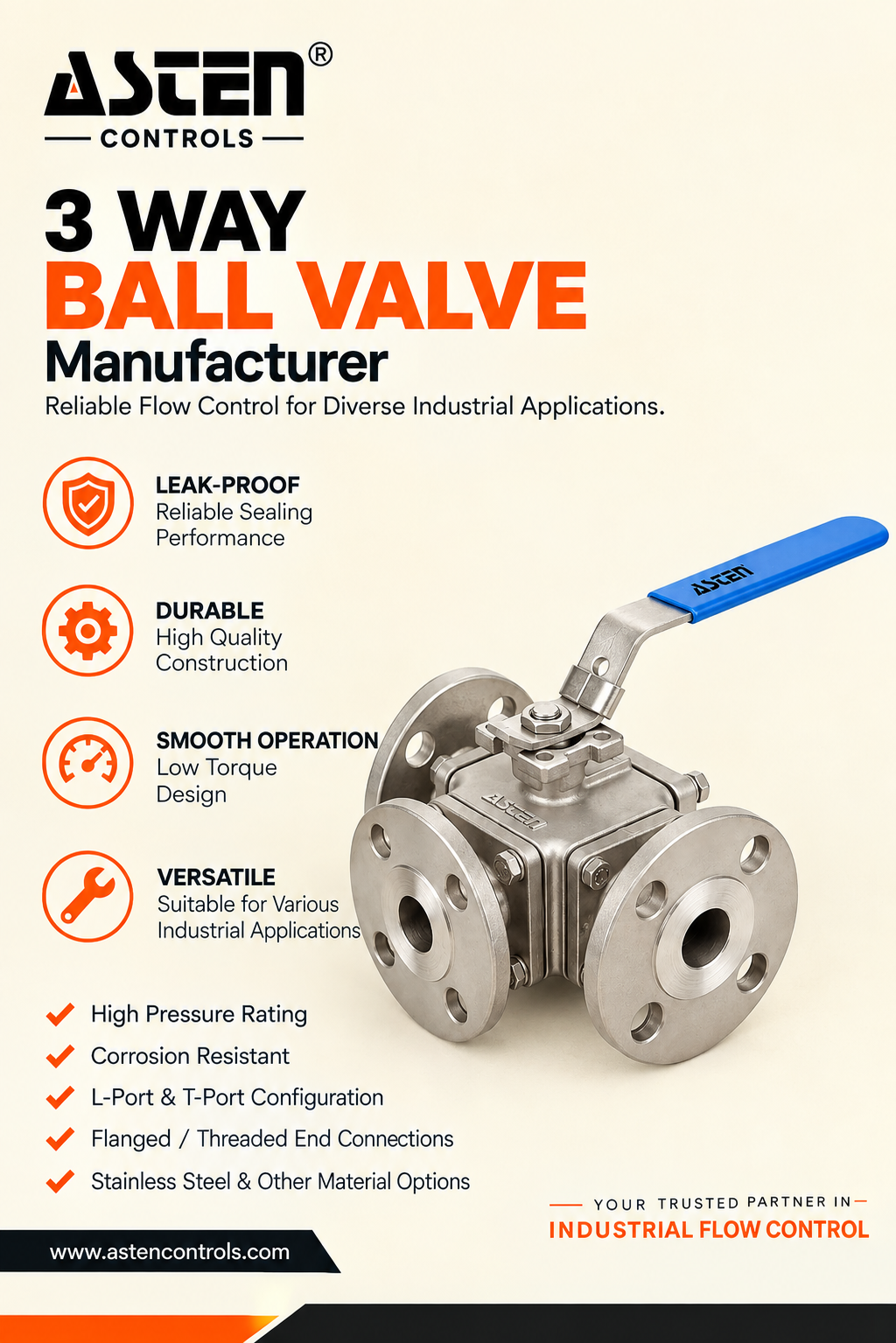
What Is a 3 Way Ball Valve?
A 3 Way Ball Valve is a quarter-turn valve containing three ports and a specially machined internal ball. The ball contains an L-shaped or T-shaped passage that determines how the process fluid moves between the connected pipelines.
When the valve handle or actuator rotates the ball, the internal passage aligns with different ports. This allows the valve to redirect, distribute, combine, or isolate flow depending on its configuration.
Unlike a conventional two-port ball valve, a three-way design provides multiple flow-routing possibilities from a single valve body.
How Does a 3 Way Ball Valve Work?
The working principle is based on the rotation of a hollow ball inside the valve body.
A typical operating sequence involves:
The valve is connected to three pipeline ports.
The internal ball contains an L-Port or T-Port passage.
A handle or actuator rotates the ball.
The internal passage aligns with the required ports.
The flow path changes according to the ball position.
A quarter-turn movement can therefore change the direction of the process media quickly.
Depending on the configuration, a three-way ball valve can be used to:
Divert flow from one pipeline to another
Distribute one inlet flow between outlets
Combine selected flow streams
Isolate a particular flow route
Change process flow direction
L Port vs. T Port 3 Way Ball Valve
One of the most important considerations when selecting a three-way ball valve is the internal port configuration.
L Port 3 Way Ball Valve
An L Port Ball Valve has an L-shaped internal passage. It is generally selected for applications where flow needs to be directed between selected ports while another port remains isolated.
L-Port configurations can be useful in:
Chemical processing
Water treatment
Pharmaceutical systems
Utility applications
Process flow diversion
T Port 3 Way Ball Valve
A T Port Ball Valve uses a T-shaped internal passage and provides additional flow-routing combinations.
Depending on the configuration, it can be used for applications involving flow distribution or mixing. T-Port valves are commonly considered where multiple process flow paths need to be managed through one valve.
The correct configuration should always be selected according to the required process flow arrangement.
Materials Used in 3 Way Ball Valves
Material selection is an important part of valve specification because the valve must be compatible with the process fluid and operating environment.
Common body materials include:
Stainless Steel
SS304
SS316
SS316L
Carbon Steel
Cast Steel
Brass
Bronze
Duplex Stainless Steel
Alloy Steel
Seat materials can include PTFE, RPTFE, PEEK, and other high-performance sealing materials.
For corrosive or demanding industrial applications, a Stainless Steel 3 Way Ball Valve may be selected because stainless steel can provide useful corrosion resistance and mechanical strength. However, the appropriate material depends on the actual process conditions, including fluid composition, temperature, pressure, and corrosion requirements.
Manual, Pneumatic and Electric Operation
Three-way ball valves can be operated manually or integrated into automated systems.
Manual Operation
A manual valve uses a handle to rotate the ball. This can be suitable for applications where frequent automatic control is not required.
Pneumatic Operation
A Pneumatic 3 Way Ball Valve uses compressed air and an actuator to rotate the valve. Pneumatic operation can be useful in industrial automation where fast and repeatable valve positioning is required.
Electric Operation
Electric actuators can be used when a valve needs to be integrated with an electrical control system. This can support remote operation and automated process control.
The choice of actuator depends on the automation requirements, operating frequency, available utilities, control architecture, and application conditions.
Industrial Applications of 3 Way Ball Valves
The ability to manage multiple flow paths makes three-way ball valves useful across numerous industries.
Chemical Processing
Chemical plants often require reliable flow diversion and isolation. Proper body and seat material selection is particularly important when handling corrosive chemicals.
Oil and Gas
Three-way ball valves can be incorporated into process and utility piping systems where flow routing and isolation are required.
Water Treatment
Water treatment facilities can use three-way configurations to redirect water between different process stages and pipelines.
Pharmaceutical Manufacturing
Pharmaceutical processes require carefully selected valve materials and configurations. Stainless steel valves may be used in suitable process applications where material compatibility and hygiene requirements are addressed.
Food and Beverage
Three-way valves can assist with process flow management in food and beverage production systems when the valve design meets the application's hygienic requirements.
HVAC
Three-way ball valves can be used for directing fluid flow in heating, ventilation, and air-conditioning systems.
Power Generation
Power-generation facilities contain complex fluid-handling networks where reliable flow routing and isolation can be important.
Other applications include pulp and paper, textiles, compressed-air systems, maritime operations, utilities, process engineering, and industrial automation.
Important Factors When Selecting a 3 Way Ball Valve
Choosing a valve should involve more than simply matching the pipeline size.
Engineers and purchasing teams should evaluate:
Flow configuration: Determine whether an L-Port or T-Port arrangement is required.
Valve size: Select a size suitable for the pipeline and required process flow.
Pressure rating: Verify that the valve is suitable for the system's operating pressure and applicable pressure-temperature conditions.
Temperature: Operating temperature can influence the selection of body, seat, and sealing materials.
Process media: Ensure that wetted materials are compatible with the fluid or gas.
Connection type: Threaded and flanged configurations can be selected according to piping requirements.
Actuation: Determine whether manual, pneumatic, or electric operation is appropriate.
Seat material: Select a suitable seat material based on temperature, pressure, chemical compatibility, and service requirements.
Correct specification can help improve reliability and reduce maintenance issues over the operating life of the valve.
3 Way Ball Valve Manufacturer in India
The industrial valve market includes manufacturers and suppliers offering different valve configurations, materials, connections, and actuation options. Buyers should evaluate technical specifications, manufacturing capabilities, quality systems, customization options, testing, and after-sales technical support before selecting a supplier.
Asten Controls is an Indian industrial valve manufacturer and supplier offering three-way ball valves in L-Port and T-Port configurations. Its product information lists manual, pneumatic, and electric operation options along with threaded and flanged connection choices. Material options include stainless steel, carbon steel, cast steel, brass, bronze, duplex stainless steel, and alloy steel.
Asten Controls also states that its three-way ball valves are used in applications including chemical processing, oil and gas, water treatment, pharmaceuticals, food and beverage, power generation, HVAC, pulp and paper, textiles, maritime applications, and industrial automation.
Why Three-Way Ball Valves Matter in Modern Process Systems
As industrial processes become increasingly automated, efficient flow management becomes an important part of system design.
A three-way ball valve can consolidate multiple flow-routing functions into one valve body. This can simplify piping arrangements and provide a convenient method of switching between different process routes.
When combined with pneumatic or electric actuation, three-way ball valves can also become part of automated process-control systems.
However, valve selection should always be based on the actual operating conditions rather than on a generic specification. Pressure, temperature, media compatibility, flow requirements, connection standards, and required flow paths all influence the appropriate valve design.
Conclusion
A 3 Way Ball Valve is a versatile flow-control component designed for industrial systems that require multiple flow paths. Its quarter-turn mechanism and three-port construction make it suitable for diverting, distributing, mixing, and isolating process flows.
The choice between L-Port and T-Port, along with the correct body material, seat material, pressure rating, connection type, and actuation method, is essential for achieving reliable performance.
For companies searching for a 3 Way Ball Valve Manufacturer in India, evaluating technical capabilities and application-specific requirements can help identify an appropriate industrial valve solution.
Asten Controls offers L-Port and T-Port three-way ball valve configurations along with manual, pneumatic, and electric operating options for a range of industrial applications.
Comments
Log in or sign up to join the conversation.