

A simple summary of the headlines for this release is that there was significant growth of productivity while the labor costs grew less. There continues too much backward revision which completely reversed trends making one wonder wtf is going on.

Analyst Opinion of Productivity and Costs
I only look at year-over-year data - the headline compounding distorts the view). I have issues with the way productivity is determined - as logic dictates that real productivity is growing through innovation.
The market was expecting:
| seasonally adjusted quarter-over-quarter at annual rate | Consensus Range | Consensus | Preliminary Actual | Final Actual |
| Nonfarm productivity | 0.9 % to 1.5 % | +1.3 % | +0.9 % | +1.5 % |
| Unit labor costs | 0.0 % to 0.6 % | +0.3 % | +0.6 % | +0.2 % |
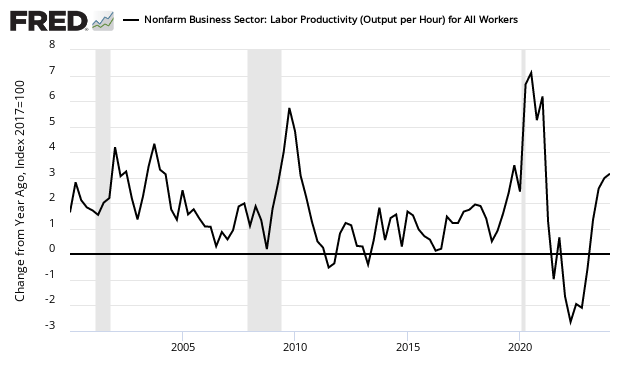
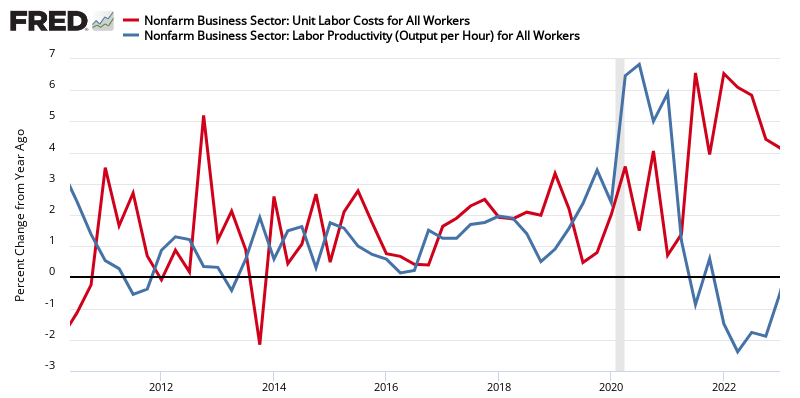
The headlines annualize quarterly results (Econintersect uses year-over-year change in our analysis). If data is analyzed in year-over-year fashion, non-farm business productivity improved 1.3 % year-over-year, and unit labor costs were DOWN 0.2 % year-over-year. Bottom line: the year-over-year data is saying that productivity growth is significantly outpacing labor costs.
Please note that the following graphs are for a sub-group of the report nonfarm > business.
Seasonally Adjusted Year-over-Year Change in Output of Business Sector

Seasonally Adjusted Year-over-Year Change of Output per Hour for the Business Sector
All this is happening while business sector unit labor costs increased.
Seasonally Adjusted Year-over-Year Rate of Change of Unit Labor Costs
The headlines from the press release:
Nonfarm business sector labor productivity increased 1.5 percent during the second quarter of 2017, the U.S. Bureau of Labor Statistics reported today, as output increased 4.0 percent and hours worked increased 2.5 percent. (All quarterly percent changes in this release are seasonally adjusted annual rates.) From the second quarter of 2016 to the second quarter of 2017, productivity increased 1.3 percent, reflecting a 2.8-percent increase in output and a 1.5-percent increase in hours worked.
Unit labor costs in the nonfarm business sector increased 0.2 percent in the second quarter of 2017, reflecting a 1.8-percent increase in hourly compensation and a 1.5-percent increase in productivity. Unit labor costs decreased 0.2 percent over the last four quarters.
Preliminary Chart for 2Q2017

Final Chart for 2Q2017

Caveats Relating to Productivity
Productivity is determined using monetary criteria, and does not recognize outsourced man hours - in other words, if a business cuts half of its workforce by outsourcing a sub-component or sub-service, this would be a 50% productivity improvement.
These productivity measures describe the relationship between real output and the labor time involved in its production. They show the changes from period to period in the amount of goods and services produced per hour. Although these measures relate output to hours at work of all persons engaged in a sector, they do not measure the specific contribution of labor, capital, or any other factor of production. Rather, they reflect the joint effects of many influences, including changes in technology; capital investment; level of output; utilization of capacity, energy, and materials; the organization of production; managerial skill; and the characteristics and effort of the work force.
Econintersect believes a better measure (if you must use monetary tools to track productivity) would be competitiveness.
Looking at productivity/output long term - output fall below 0% year-over-year change is a good sign that a recession is underway. Another way to look at it - if productivity rate of gain is falling, this could be an indicator a recession is coming.


Comments
Log in or sign up to join the conversation.