
By 2026, Texas retailers can no longer treat “online” and “in‑store” as separate funnels. For Texas brands investing in “Texas ecommerce platform builders,” the real competitive edge lies in omnichannel ecommerce: a single, unified experience that follows the customer from social media scroll to mobile app, from physical store to curbside pickup, all powered by a flexible commerce platform.
National ecommerce forecasts show online sales continuing to grow at a double‑digit rate, with U.S. consumers now expecting immediate fulfillment, consistent pricing across channels, and seamless returns. In Texas, where tech growth is ticking up about 15% year‑on‑year and statewide ecommerce spend is projected to be near 200 billion dollars, brands that fail to unify their channels risk losing customers to more agile, platform‑driven competitors.
This article explains how Texas‑based businesses can use modern ecommerce platforms to build truly omnichannel experiences in 2026, including what to look for in “Texas ecommerce platform builders,” key technical components, and how to align omnichannel strategy with Texas‑market behavior.
Why omnichannel matters for Texas brands
What “omnichannel ecommerce” really means
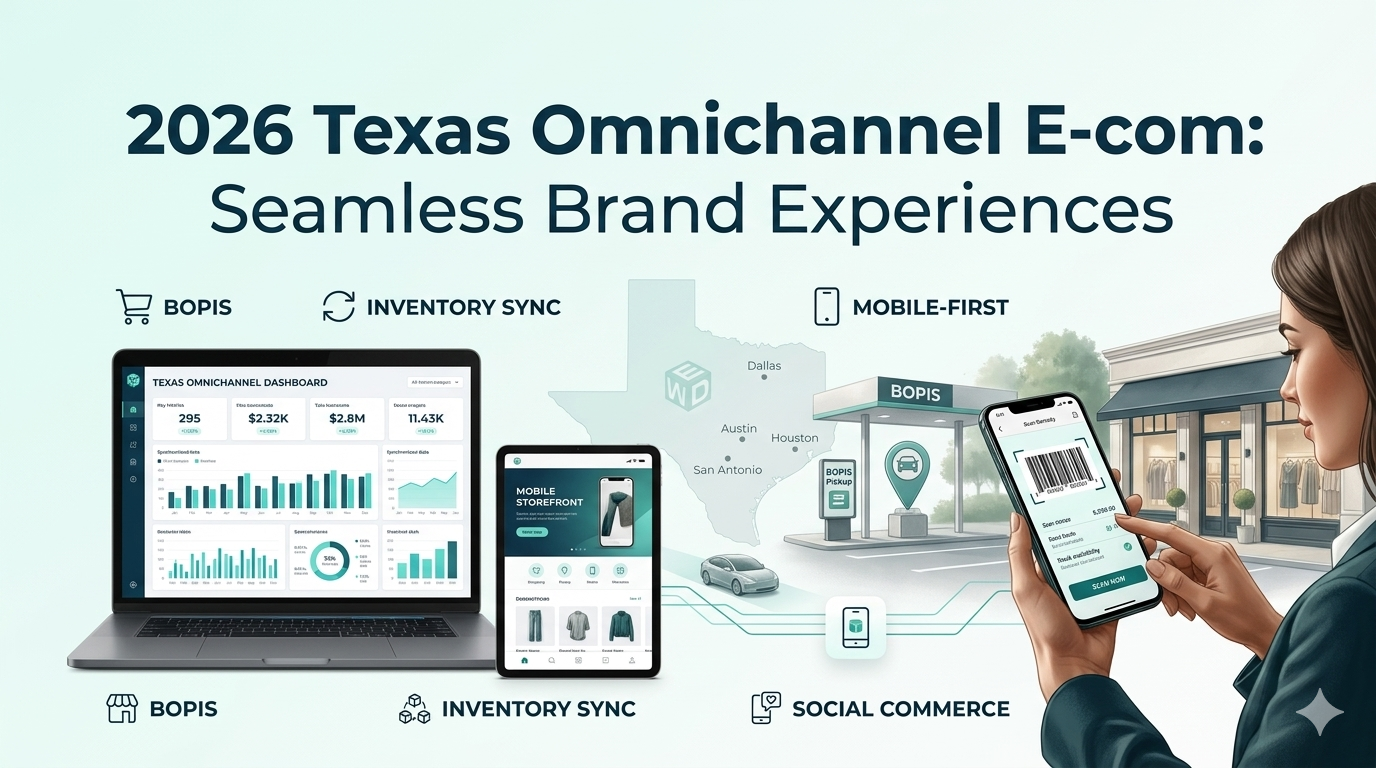
Omnichannel ecommerce goes beyond “online + store.” It means that no matter where a Texas shopper interacts with a brand—on a website, mobile app, social checkout, in‑store display, or call center—inventory, pricing, promotions, and loyalty status are synchronized in real time.
For Texas brands, this translates into experiences like:
Buying online and returning in‑store.
Browsing in a Houston store, then completing checkout on a mobile app.
Adding items to a cart on Instagram, then servicing the order from a Dallas‑area warehouse.
Each of these touchpoints is powered by a central commerce platform that handles catalog, pricing, inventory, and payments, while the frontend channels (web, app, POS, kiosk) simply consume that data.
How omnichannel boosts Texas ecommerce metrics
Texas retailers that adopt omnichannel strategies typically see higher average order value, lower cart abandonment, and stronger retention. Customers who shop across multiple channels tend to spend more over time and are more likely to participate in loyalty programs when points and rewards are visible everywhere.
For Texas‑based brands, this is especially powerful during seasonal peaks—back‑to‑school, Thanksgiving, and Texas‑specific events such as football weekends or state‑fair season—where shoppers move fluidly between online browsing and in‑store purchases.
The role of Texas ecommerce platform builders
Texas brands that want to move beyond “connect‑the‑dots” integrations often rely on “Texas ecommerce platform builders” to design and implement a unified commerce backbone. These specialists help:
Choose the right platform (SaaS, headless, or custom) based on business size and growth targets.
Integrate POS systems, warehouse management, and delivery APIs into a single ecosystem.
Ensure the platform can scale as Texas ecommerce spend grows toward 200 billion dollars.
By partnering with experienced Texas ecommerce platform builders, Texas brands can avoid siloed tools and fragmented data, laying the groundwork for a genuinely seamless customer journey.
Key omnichannel trends shaping Texas 2026
Buy‑online, pick‑up‑in‑store (BOPIS) and curbside
Texas shoppers increasingly expect BOPIS and curbside options, especially in larger metro areas such as Dallas–Fort Worth, Houston, and Austin. In 2026, many Texas retailers are using their ecommerce platforms to sync local store inventory so customers can see real‑time availability and reserve items for pickup.
For Texas brands, this means the platform must:
Track inventory at the store level, not just at the warehouse.
Automatically update availability when items are reserved or sold.
Notify customers via SMS or app alerts when their order is ready.
Texas ecommerce platform builders are now embedding these capabilities into the core of the commerce stack, so BOPIS feels like a natural feature of the brand, not an add‑on.
Social and marketplace channel sync
Texas consumers are active on social media and marketplaces like Amazon, eBay, and TikTok Shop, so omnichannel strategies increasingly include syncing catalog and stock to these channels. For Texas brands, this means the ecommerce platform must push product data, pricing, and inventory updates out to third‑party marketplaces and social‑shopping tools via APIs.
In 2026, Texas ecommerce platform builders are prioritizing marketplace connectors and multi‑channel inventory engines that minimize overselling and ensure consistent promotions across all touchpoints. This is especially important for Texas‑based D2C brands that want to own the customer relationship while still leveraging major marketplaces.
Loyalty and rewards across channels
Texas brands that get omnichannel right also unify loyalty programs across channels. A shopper in San Antonio who earns points in‑store should be able to redeem them in the mobile app, while a Houston customer who browses the website should see the same personalized offers and rewards in‑store kiosks.
This requires a flexible customer‑data layer inside the ecommerce platform, tied to CRM and analytics systems. Texas ecommerce platform builders are increasingly using first‑party data models and identity‑resolution tools to keep rewards and personalization consistent, even as consumers move between devices and touchpoints.
Building a Texas‑ready omnichannel platform
Core components of a Texas omnichannel stack
For Texas brands, an effective omnichannel strategy starts with a robust platform backbone. Key components include:
A central product and catalog engine that defines SKU, pricing, taxes, and promotions once and distributes them everywhere.
An omnichannel order and inventory management system that tracks stock across warehouses, local stores, and marketplaces in real time.
A unified customer data layer that aggregates behavior from web, mobile, email, and in‑store interactions for segmentation and personalization. Texas ecommerce platform development partners often layer APIs for payments, shipping, tax, and CRM on top of this core, creating a “hub‑and‑spoke” architecture that keeps the customer experience seamless but the backend flexible.
Mobile‑first design for Texas shoppers
Texas consumers are highly mobile‑oriented, so Texas‑based omnichannel platforms are designed with mobile‑first principles. Product pages, checkout flows, and account features are optimized for touch, small screens, and variable network speeds, especially in more rural or underserved parts of the state.
Texas ecommerce platform builders also ensure that the mobile app and mobile web experience feel like extensions of the in‑store brand, with consistent language, imagery, and UX patterns. This continuity helps Texas shoppers switch channels without re‑learning how to use the brand.
Local SEO and Texas‑specific UX
Even in an omnichannel world, many Texas shoppers discover brands via local search terms such as “furniture store near me” or “Austin‑made skincare.” Texas ecommerce platforms must therefore support location‑aware content, local store pages, and geo‑targeted promotions that reflect regional tastes and seasons.
Texas ecommerce platform builders help brands structure URLs, schema markup, and title tags so that local‑search intent is clearly communicated to search engines. This ensures that Texas‑market SEO remains strong even as the brand adds more channels and touchpoints.
How Texas brands are using omnichannel platforms
Texas D2C consumer‑brand example
A Texas‑based D2C skincare brand operating primarily online expanded its omnichannel footprint in 2025 by integrating a Texas‑designed ecommerce platform into its strategy. The platform unified:
Direct‑to‑consumer web sales.
Social‑commerce storefronts (Instagram and TikTok).
Pop‑up events and in‑store kiosks in select Texas malls.
By syncing inventory, loyalty, and promotions across all channels, the brand was able to grow average order value by 23% and increase customer lifetime value, especially in Texas markets where in‑person experiences were highly valued.
Texas retail group with physical stores
A Texas retail group with 50+ physical locations adopted an omnichannel platform in 2024 to support BOPIS, curbside, and unified returns. The platform connected legacy POS systems to a central inventory engine, enabling real‑time stock visibility across the state.
Sales associates in Texas stores could now check inventory in neighboring locations, place online orders on behalf of customers, and apply loyalty points to every transaction. This shift reduced missed sales and improved customer satisfaction, especially during peak Texas‑market events such as Black Friday and local holiday festivals.
Texas marketplace‑style brand
A Texas marketplace‑style brand operating a multi‑vendor platform for local artisans and small businesses built its omnichannel stack around a flexible commerce core. The platform supported:
Vendor‑managed inventory and fulfillment options.
Texas‑specific delivery and pickup zones.
Consistent branding and UX across web, mobile, and social channels.
By working with Texas ecommerce platform development partners, the brand was able to launch city‑specific promotions—such as Austin‑only collections or Houston‑focused bundles—without duplicating backend logic. This approach helped the marketplace stand out in Texas‑market search and social channels.
Working with Texas platform partners
Choosing the right Texas ecommerce platform builders
Texas brands should evaluate “Texas ecommerce platform builders” based on several criteria:
Experience with Texas‑specific challenges (large geography, multi‑region fulfillment, and diverse demographics).
Proven track record in omnichannel projects, including BOPIS, social commerce, and multi‑store integrations.
Technical depth in API‑driven architectures, headless commerce, and composable platforms.
For many Texas businesses, the best fit is a partner that offers end‑to‑end design, development, and post‑launch support, ensuring that the platform evolves as the Texas ecommerce market matures.
FAQs
1. What is omnichannel ecommerce for Texas ecommerce platform builders?
Omnichannel ecommerce for Texas ecommerce platform builders means designing a unified commerce backbone that syncs online, mobile, in‑store, and marketplace channels so customers experience consistent pricing, inventory, promotions, and loyalty, no matter where they interact with the brand.
2. Why are Texas ecommerce platform builders important for Texas brands?
Texas ecommerce platform builders help Texas brands unify fragmented systems, reduce overselling, and deliver seamless experiences across channels, which is critical as Texas ecommerce spend grows toward 200 billion dollars and customers expect instant, flexible service.
3. How do BOPIS and curbside fit into Texas omnichannel platforms?
BOPIS and curbside are embedded into Texas omnichannel platforms by syncing local-store inventory, enabling real‑time reservations, and triggering SMS or app alerts when orders are ready, turning physical locations into fulfillment hubs rather than isolated stores.
4. Can social commerce be part of Texas omnichannel strategy?
Yes; Texas brands can integrate social‑commerce features—such as Instagram Shop or TikTok Shop—into their omnichannel platform so catalog, pricing, and inventory are synced across social, website, and in‑store channels, ensuring a consistent experience.
Comments
Log in or sign up to join the conversation.