

Each year, here at Russell Investments we examine the largest defined benefit (DB) plans, those with liabilities of $20 billion and above, which we refer to as the $20 billion club. This collection of jumbo-sized plan sponsors are uniquely situated to set the trends that the industry may follow. The following report provides an update on these plans’ experience over 2018. We have reviewed the changes made by plan sponsors over the year as they continue the trend of de-risking and protecting their large investments in these plans.
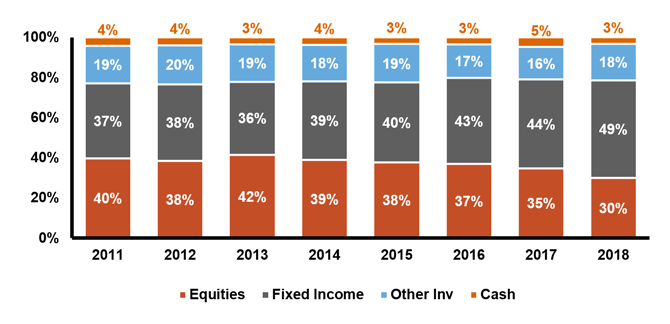
After several years of little news on the investment policy front, there have been big changes in asset allocations for the $20 Billion Club. Fixed-income allocations are up 5%, while equity allocations are down 5%. This shift in asset allocation is the largest de-risking move in recent history in a continuing shift out of risky assets. While some of this could be attributed to the fourth-quarter downturn, some companies have indicated intentions to de-risk their plan assets, such as Honeywell after a 19% increase to fixed income from 2017.
(Click on image to enlarge)
Source: 10-k filings
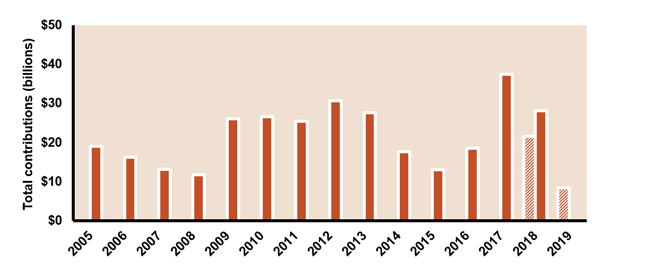
The $20 billion club also continues to funnel money into their plans. While the $20 billion club contributions were down from the record-breaking contributions in 2017, they were still at historic highs in 2018. Discount rates rebounded by 60 basis points (bps) from the lows in 2017, leading to significant increases in funded status. However, larger gains were not to be, as the global equity markets experienced severe difficulties during the fourth quarter.
Contributions and discount rate increases overcame the fourth quarter equity troubles to ultimately bring funded status up by 1% on average to 85%. ELTRA (expected long-term return on assets) also continues to decrease, as plan sponsors shift out of equities and into fixed income. In 2018, the $20 billion club saw an average decrease of 30bps, the largest decrease in the past eight years.
The $20 billion club continues to adjust the benefits policy to decrease plan costs and risks. This was no different for 2018, as several plans had freezes go into effect and executed annuity purchases. De-risking can be seen in the decreasing service cost to the projected benefit obligation (PBO) ratio, which showed the third-largest decrease since the Pension Protection Act (PPA) was passed.
Plan sponsors continued to take advantage of the tax benefits associated with the Tax Cuts and Jobs Act of 2017, which ended for the calendar year plans on September 15, 2018. Together 2017 and 2018 saw the largest two years of contributions in recent history, as 2017 was a record high year and actual 2018 contributions were 30% higher than expected. These circumstances have encouraged plan sponsors to prefund their plans. Contributions are expected to drop off a cliff as expected. 2019 contributions are down 77% from the high in 2017 and for some years after in certain cases. Exhibit 2 illustrates the contribution timing around other legislative events.
(Click on image to enlarge)
Source: 10-k filings
All these actions come together to continue the de-risking path that these jumbo-sized plans have been on for the past several years. The traditional asset-only allocation seen in the past appears to truly be a thing of the past, with the $20 billion club firmly at the forefront of the movement.



Comments
Log in or sign up to join the conversation.