
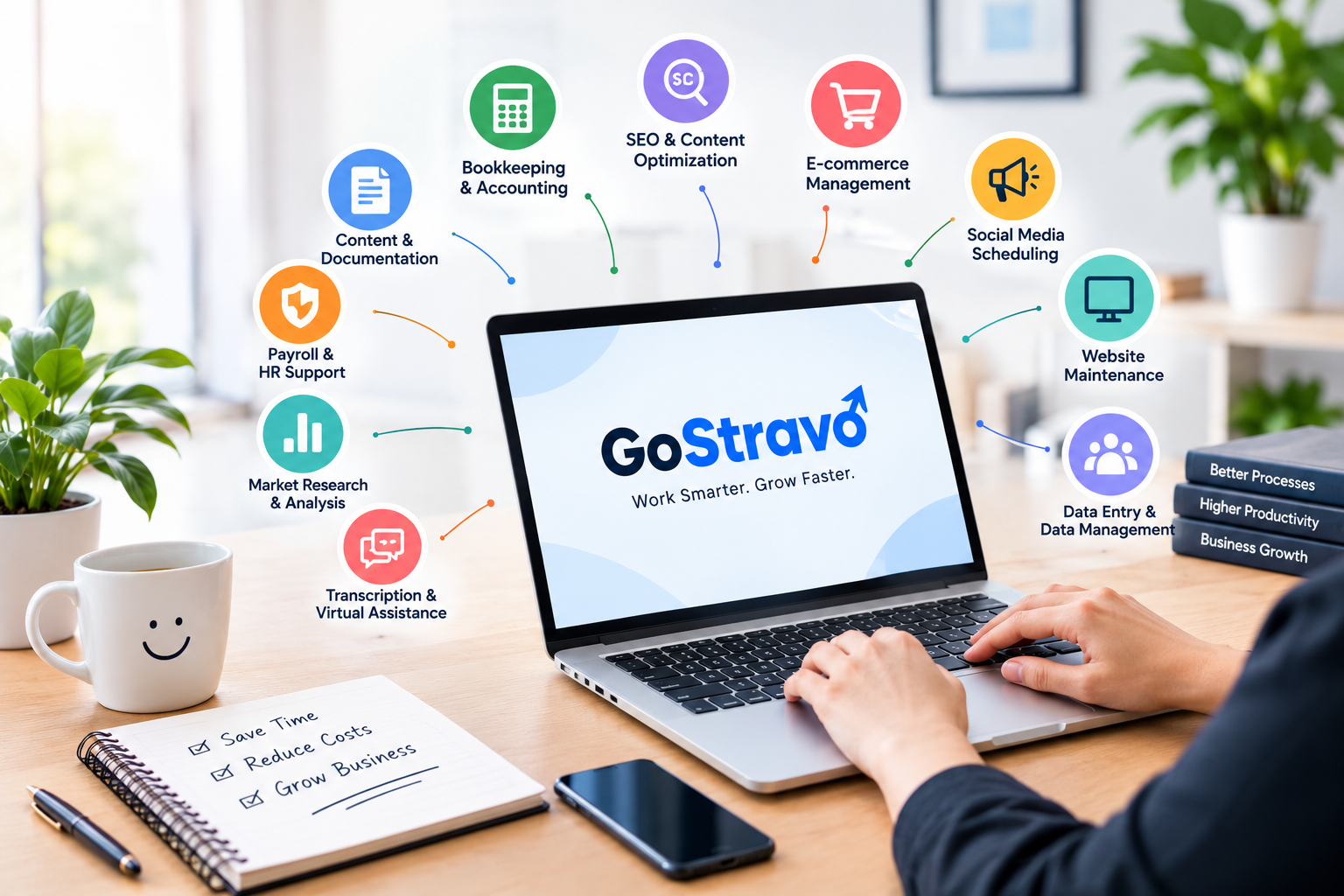
Stravo helps businesses simplify complex operations through smart outsourcing. Running a business involves much more than selling products or serving customers. Behind every successful company are dozens of daily tasks, from bookkeeping and data management to social media, website maintenance, customer communication, and online store management.
As a business grows, these routine responsibilities can consume valuable time. Business owners and internal teams may find themselves spending hours on tasks that do not directly contribute to growth.
This is where business outsourcing can make a significant difference.
Outsourcing allows businesses to delegate specific operational tasks to experienced professionals while their internal teams focus on strategy, customers, innovation, and growth. A well-planned outsourcing strategy can help businesses improve efficiency, control operating costs, and access specialized expertise without building a large in-house team.
Here are 10 business tasks that companies can consider outsourcing.
1. Bookkeeping and Accounting Support
Financial records are one of the most important parts of running a business, but bookkeeping can also be time-consuming. Businesses need to record transactions, reconcile accounts, monitor expenses, prepare financial reports, and keep their records organized. Outsourcing bookkeeping can help businesses maintain accurate financial records while reducing the workload for business owners and internal teams.
Professional bookkeeping support may include:
Recording income and expenses
Account reconciliation
Monthly financial reporting
Profit and loss reporting
Balance sheet preparation
Cash-flow tracking
Maintaining organized financial records
With accurate and regularly updated books, business owners can make better decisions based on reliable financial information.
2. Data Entry and Data Cleaning
Businesses generate large amounts of information every day. Customer details, product information, spreadsheets, CRM records, invoices, inventory data, and other documents all need to be organized and maintained. Manual data entry can take considerable time and can also lead to errors when handled without proper processes. Outsourcing data entry and cleaning can help businesses maintain more organized and reliable information.
Common outsourced data tasks include:
Spreadsheet updates
CRM data management
Data validation
Duplicate record removal
Database maintenance
Product data entry
Document organization
Clean and accurate data can make everyday business operations more efficient and improve decision-making.
3. SEO and Content Optimization
Having a website is only the beginning of building an online presence. Businesses also need to make sure potential customers can discover their website through search engines. SEO involves keyword research, competitor analysis, content optimization, technical improvements, and performance monitoring. For businesses without an internal SEO team, outsourcing these activities can provide access to specialized knowledge and tools.
An outsourced SEO team can support areas such as:
Keyword research
Competitor analysis
Content gap analysis
SEO content briefs
On-page optimization
Website SEO audits
Ranking performance reports
AI-powered SEO can also help businesses analyze large amounts of search data and identify opportunities more efficiently.
4. E-commerce Store Management
Managing an online store involves much more than adding products to a website. E-commerce businesses need to update product listings, monitor inventory, process orders, communicate with customers, manage returns, and keep product information accurate. As an online store grows, these tasks can quickly become difficult for a small internal team to manage. Outsourcing e-commerce operations can help businesses maintain their stores while allowing owners to concentrate on sales and growth.
Typical e-commerce support can include:
Product uploads
Product descriptions
Inventory updates
Order processing
Order tracking
Customer communication
Returns management
Store administration
A reliable operational system can create a smoother experience for both the business and its customers.
5. Social Media Scheduling
Social media is an important part of modern digital marketing, but maintaining consistency across multiple platforms requires time. Businesses need to plan content, create graphics, write captions, research hashtags, schedule posts, monitor engagement, and review performance. When these tasks are handled manually by business owners, social media can become another major responsibility. Outsourcing social media scheduling can help businesses maintain a consistent online presence.
Professional support may include:
Content calendar planning
Social media scheduling
Caption writing
Canva-based graphic creation
Hashtag research
Engagement monitoring
Performance reporting
The goal is not simply to post more often. It is to create a consistent and organized social media presence that supports the overall marketing strategy.
6. Website Maintenance
A business website needs regular attention after it is launched. Software and plugins may require updates, website content may need to be changed, links can break, and security and backup processes need ongoing monitoring. Ignoring website maintenance can eventually affect performance, security, and user experience.
Outsourced website maintenance can include:
CMS and plugin updates
Security monitoring
Website backups
Broken-link checks
Content updates
Image uploads
Performance checks
Regular maintenance helps businesses keep their online presence professional, functional, and up to date.
7. Market Research
Making business decisions without understanding customers, competitors, pricing, and market trends can be risky. Market research provides information that can help businesses understand their industry and identify potential opportunities. Instead of spending internal resources collecting and organizing research, companies can outsource specific research projects.
Market research support can include:
Competitor analysis
Customer research
Market trend analysis
Pricing research
Product research
Industry benchmarking
Strategic reports
The most useful research is not simply a collection of numbers. It should turn information into practical insights that help decision-makers understand what to do next.
8. Transcription and Documentation
Meetings, webinars, podcasts, interviews, and business discussions can generate valuable information, but reviewing recordings and turning them into organized documents can take hours. Outsourced transcription and documentation services can convert audio or video content into structured written information.
Businesses may outsource:
Meeting transcription
Podcast transcription
Webinar documentation
Meeting notes
SOP documentation
Digital document organization
Good documentation can help teams preserve knowledge, improve communication, and make important information easier to find.
9. Payroll and Timesheet Processing
Payroll requires accuracy and consistency. Businesses need to collect timesheets, review working hours, calculate payments, and maintain organized records. For growing businesses, payroll administration can become another time-consuming back-office responsibility. Outsourcing payroll and timesheet processing can reduce administrative workload and allow internal teams to focus on more important business activities.
Depending on the business and service arrangement, support may include:
Timesheet collection
Payroll preparation
Attendance data processing
Deduction calculations
Payroll record organization
Compliance-related checks
Businesses should always ensure that payroll processes follow the applicable laws and requirements in their jurisdiction.
10. Review and Reputation Monitoring
Online reviews can strongly influence how potential customers perceive a business. Customers may check Google reviews, social media comments, marketplace ratings, or other online feedback before deciding whether to buy from a company. Monitoring these channels manually can become difficult as a business grows. Outsourced reputation monitoring can help businesses track customer feedback and identify issues more quickly.
Services may include:
Review monitoring
Feedback alerts
Customer sentiment tracking
Positive review identification
Reputation reports
Response support
Monitoring feedback regularly gives businesses an opportunity to understand customer concerns and improve their overall customer experience.
Read More: Website Maintenance
Why Should Businesses Outsource These Tasks?
Outsourcing is not simply about reducing the number of employees or finding the cheapest provider. The real objective is to build a more efficient business operation.
Save Valuable Time
Routine administrative work can take hours away from business owners and managers.By delegating repetitive tasks, internal teams can spend more time on strategic activities, customer relationships, sales, and business development.
Reduce Operational Costs
Building an in-house team for every business function can require salaries, training, software, equipment, management, and other overhead costs.Outsourcing selected activities can provide access to specialized support without requiring a full internal department for every function.
Access Specialized Expertise
Some business tasks require specific knowledge. SEO, bookkeeping, e-commerce management, data cleaning, and digital marketing all have their own processes and best practices.Outsourcing gives businesses an opportunity to work with people who specialize in these areas.
Scale More Easily
Business needs can change quickly. A company may need additional support during a product launch, seasonal period, marketing campaign, or growth phase.A scalable outsourcing model can make it easier to increase or adjust operational support as business requirements change.
Focus on Core Business Activities
Perhaps the biggest benefit of outsourcing is focus. Business owners should spend their time thinking about customers, products, services, strategy, and growth—not constantly managing repetitive administrative tasks.
What Should You Outsource First?
Not every business should outsource everything.
A better approach is to identify tasks that are:
Repetitive
Time-consuming
Process-driven
Administrative
Specialized
Easy to measure
Not part of your company's core competitive advantage
Start with one or two areas where your team is spending too much time.Measure the results, improve the workflow, and then consider expanding outsourcing to other areas.
Choosing the Right Outsourcing Partner
Choosing an outsourcing provider requires more than comparing prices.
Look for a partner that offers:
Clear Communication
You should know what work is being completed, when it will be delivered, and who is responsible for it.
Reliable Processes
Good outsourcing depends on documented workflows, quality checks, and consistent delivery.
Data Security
If your provider handles financial, customer, or business information, security and confidentiality should be important considerations.
Scalable Services
Your outsourcing partner should be able to adapt as your business grows or your requirements change.
Transparent Reporting
Regular reports and performance updates help you understand whether outsourcing is actually improving your operations.
How Stravo Helps Businesses Work Smarter
Stravo provides smart, scalable outsourcing support designed to help businesses simplify complex operational tasks. Its services include bookkeeping, AI-powered SEO, e-commerce management, social media scheduling, website maintenance, market research, data entry and cleaning, transcription, payroll support, and reputation monitoring. The company's approach focuses on helping businesses reduce operational workload while maintaining accuracy, consistency, and flexibility. For example, businesses can use outsourced bookkeeping to keep financial records organized, SEO support to improve online visibility, e-commerce support to manage daily store operations, and social media scheduling to maintain a consistent digital presence.
Final Thoughts
Outsourcing can be a powerful strategy for businesses that want to save time, improve efficiency, and focus on growth. From bookkeeping and data entry to SEO, e-commerce, social media, website maintenance, and market research, many routine business functions can be handled by specialized external teams.
The key is to outsource strategically.
Start with tasks that consume significant time but do not require your internal team to handle them personally. Choose a reliable partner, establish clear processes, monitor performance, and gradually expand the areas where outsourcing creates value. When done correctly, outsourcing is not just about getting tasks off your team's workload. It is about creating a smarter, more flexible operation that gives your business more room to grow.
Ready to Simplify Your Business Operations?
If your team is spending too much time on repetitive back-office, digital, or administrative tasks, Stravo can help you build a more efficient workflow with scalable outsourcing support. Explore the services available at GoStravo and identify the areas where your business can save time, improve consistency, and focus more on growth.
Comments
Log in or sign up to join the conversation.