

In his latest weekly Flow Show, and the last such report before what may be the most important election in history, Bank of America (BAC) CIO Michael Hartnett writes that according to the latest EPFR data, investors allocated $6.7 billion into bonds and $0.1 billion into gold, while pulling $2.1 billion out of equities and $1.5 billion out of cash.
Of note, Hartnett points out that HY bond outflows accelerated to $3.4 billion, while tech inflows were a strong $1.0 billion heading into EPS.

While the inflows to Japan were largest since April of 2019 at $3.5 billion, inflows into EM equities at $2.8 billion were the largest in seven weeks, and European equities saw the largest outflow in five months at $3.4 billion as virus lockdowns returned.
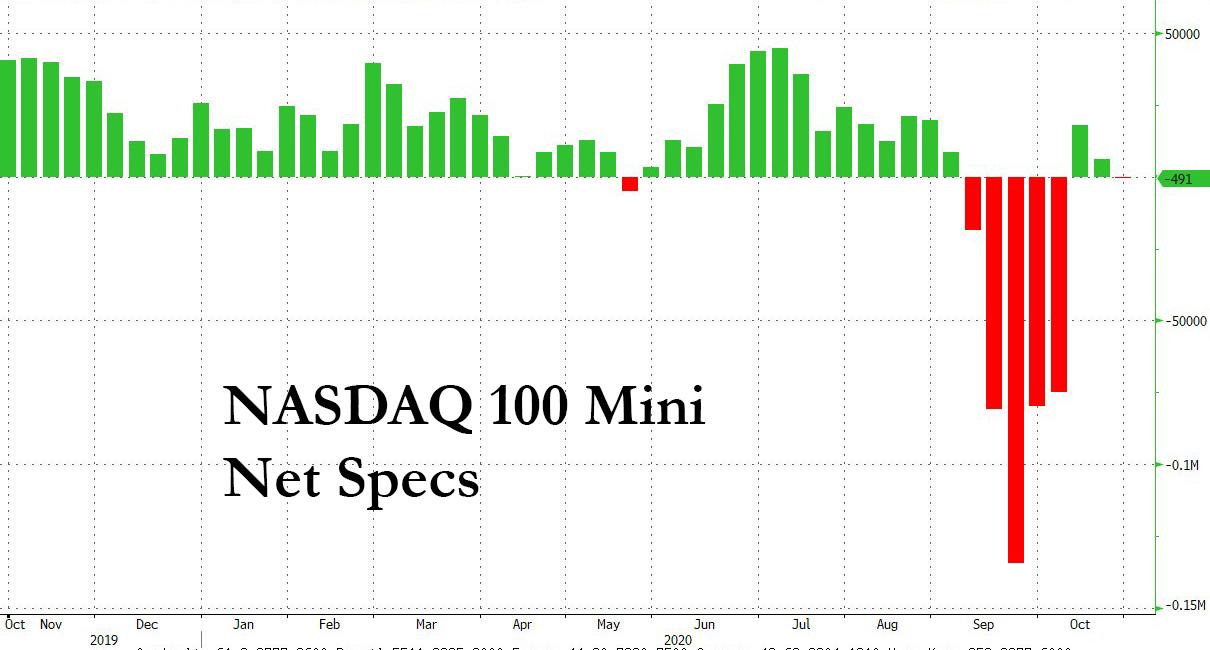
Yet, while the weekly flows are informative, we can now definitively conclude that they are nothing more than noise as the "smart money" investors merely chase momentum. How do we know this? Because four weeks after the Nasdaq 100 mini futures saw a near record number of shorts, those same "valiant" bears promptly covered their positions and even went long the NQ just in the time for the biggest Nasdaq rout since March.
In short: while flows may have had some signal value in the past, it's now nothing more than noise.
With that said, we do want to point out something else in Harnett's latest note, namely his list of ten "Big" things every investor should be aware of heading into the election. And so, here are the 10 big things to watch for:
- Big top: IPOs ($35 billion largest ever, IPO ETF +163% since March), M&A (October 2020 acquisition premium 142% vs 23% LTA), record $3.2 trillion funds raised in IG/HY/bank loans/equity/SPACs, US house prices up 15%, narrow equity leadership (top 5 SPX stocks = 24% of index), greedy IG & tech inflows, technical “double-top," bearish narratives flipping to bullish (e.g. “Blue Wave”): all classic “toppy” signs.
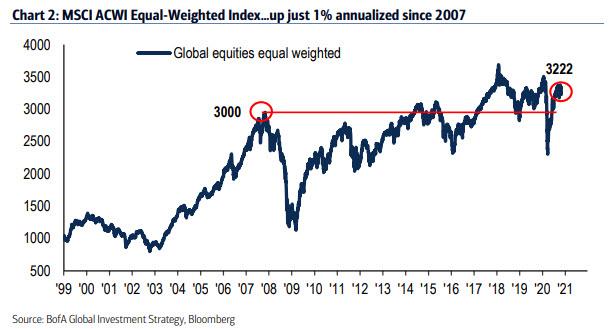
- Big not: the strongest case against “top” is the Fed not tightening (as it was ‘80, ‘87, ‘94, ‘98, ‘00, ‘08, ‘18), and most stocks not in bull market -- annualized gain in global stocks since 2007 is less than 1% (Chart 2); 1984 of 3042 in MSCI ACWI index in bear market, i.e. are more than 20% below their all-time highs.
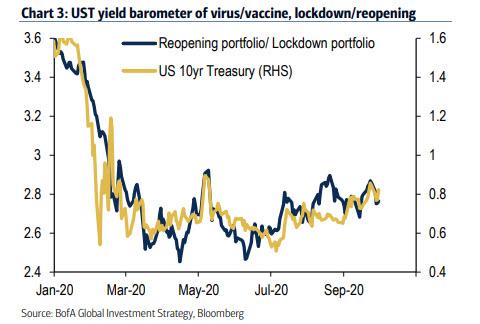
- Big contrarian: most contrarian trade in 2020 very clearly is “Fight the Fed,” because in the past 13 years central banks have cut rates 972 times, bought $19 trillion of financial assets via QE, introduced NIRP, ZIRP, YCC, TLTROs, and they are still easing as both BoC & ECB “eased” this week. Once again, virus fear transitions into vaccine hopes and lockdown assets move into reopening assets. As well, Treasury yields fail to break to new highs (>1% - Chart 3) and big contrarian rotation awaits vaccine/sustained recovery and fiscal panic/MMT.
- Big tells: max bearish signals that it’s time to “Fight the Fed:"
- Weak macro causes Treasury yields to fall and credit spreads to rise (deflation “tell”).
- MMT/digital currency causes Treasury yields to rise and US dollar to fall (inflation “tell”); investors will buy dips until Fed failure is visible.
- Big levels: Q4 tactical SPX trading range of 3300-3600 holding; SPX 3300 floor is to hold as long as LQD is more than $130, HYG is more than $80, and NDX is higher than 11000. In the coming weeks, monetary & fiscal easing + vaccine expectations mean October trading sell-off in credit & equity ends.
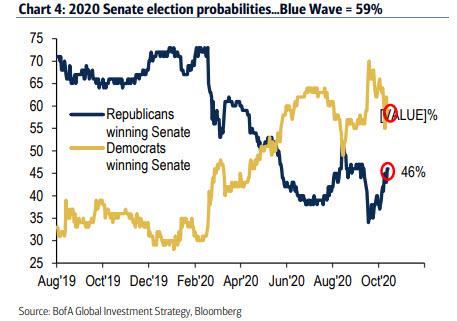
- Big event: the likelihood of Democrats winning the Senate is now at 59% (was 29% in January, 64% in July, and 49% at end of August – Chart 4). The optimal medium-term election outcome for Wall Street is “gridlock = goldilocks." The optimal outcome for big rotation is a Blue Wave.
- Big inflation themes: the election won’t change secular themes, such as "bigger world" (China war, reshoring), “bigger government” (monetary/fiscal/corporate/social/environment intervention), and “dollar debasement” (debt/MMT/digital currencies), all of which are inflation trends.
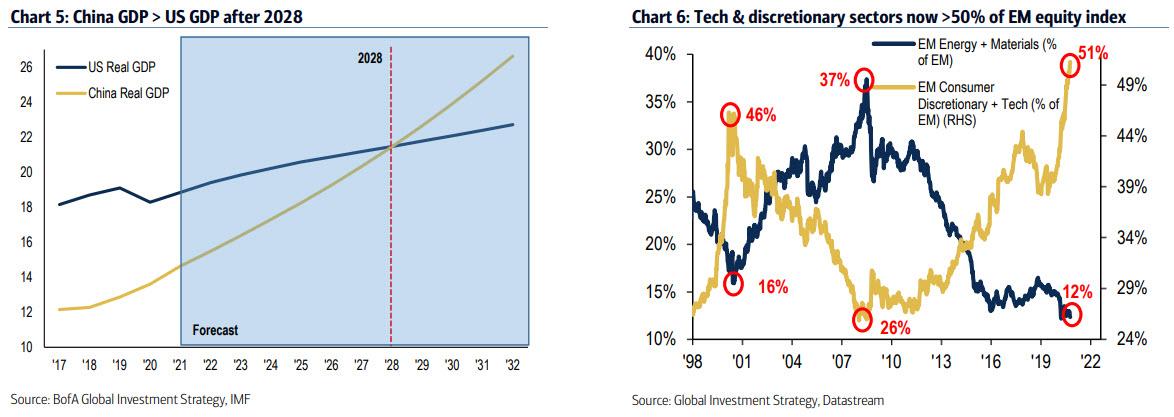
- Big deflation theme: “China tech disruption” (Chart 6 - new five-year plan for 5% growth driven by tech-led domestic urban consumption/production). Bullish deflationary trend (c/o “new paradigm” US late-90's). Note that this includes:
- China FX strength.
- China GDP set to surpass US in 2029 (Chart 5 – source IMF);
- China’s old plan (weak FX, excess credit, social finance, infrastructure spend) set to become America/Europe’s new plan.
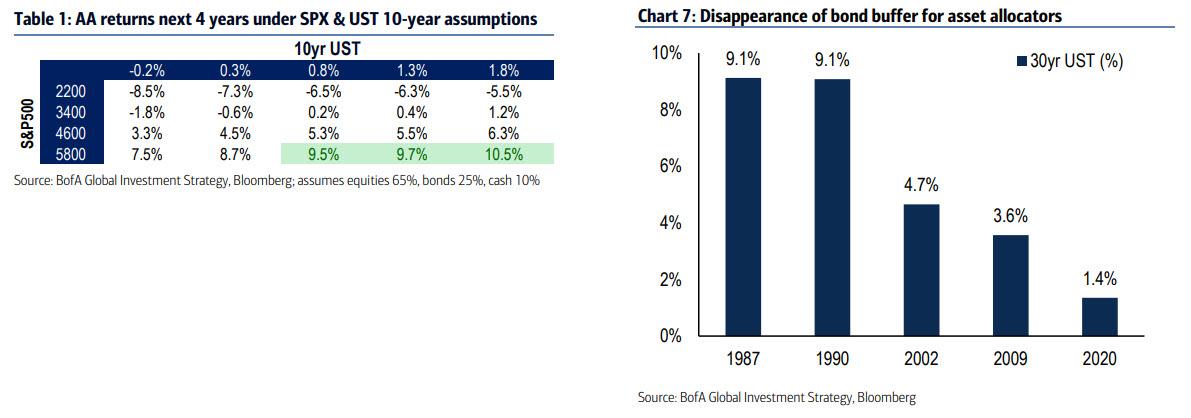
- Big dilemma: AA of 65/25/10 stocks/Treasuries/cash returned 9.4% in the past ten years. Potential AA returns expected to be much lower over the next four years, unless the SPX reaches the 5800 area and 10-year UST yield becomes less than 0.8% (Table 1). We say 3-5% asset returns are more likely. The disappearance of bond buffer for asset allocators (30-year yield was 10% in ’80, 9% in ’90, 6% in ’00, 5%, in ‘10, and now 1.5% - Chart 7) means higher volatility on Wall Street in 2020's (watch risk parity RPAR ETF as lead indicator).
- Big change: The 2020's will be characterized by bigger government action, MMT, 99% >1%. Central bank digital currencies facilitate “helicopter drops” (instantaneous payments to distribute tax refunds, stimulus, UBI, student loan forgiveness) and make negative interest rates more efficient (adjusting reserves at CB accounts at negative rate dispenses with issue of bank intermediation).



Comments
Log in or sign up to join the conversation.