
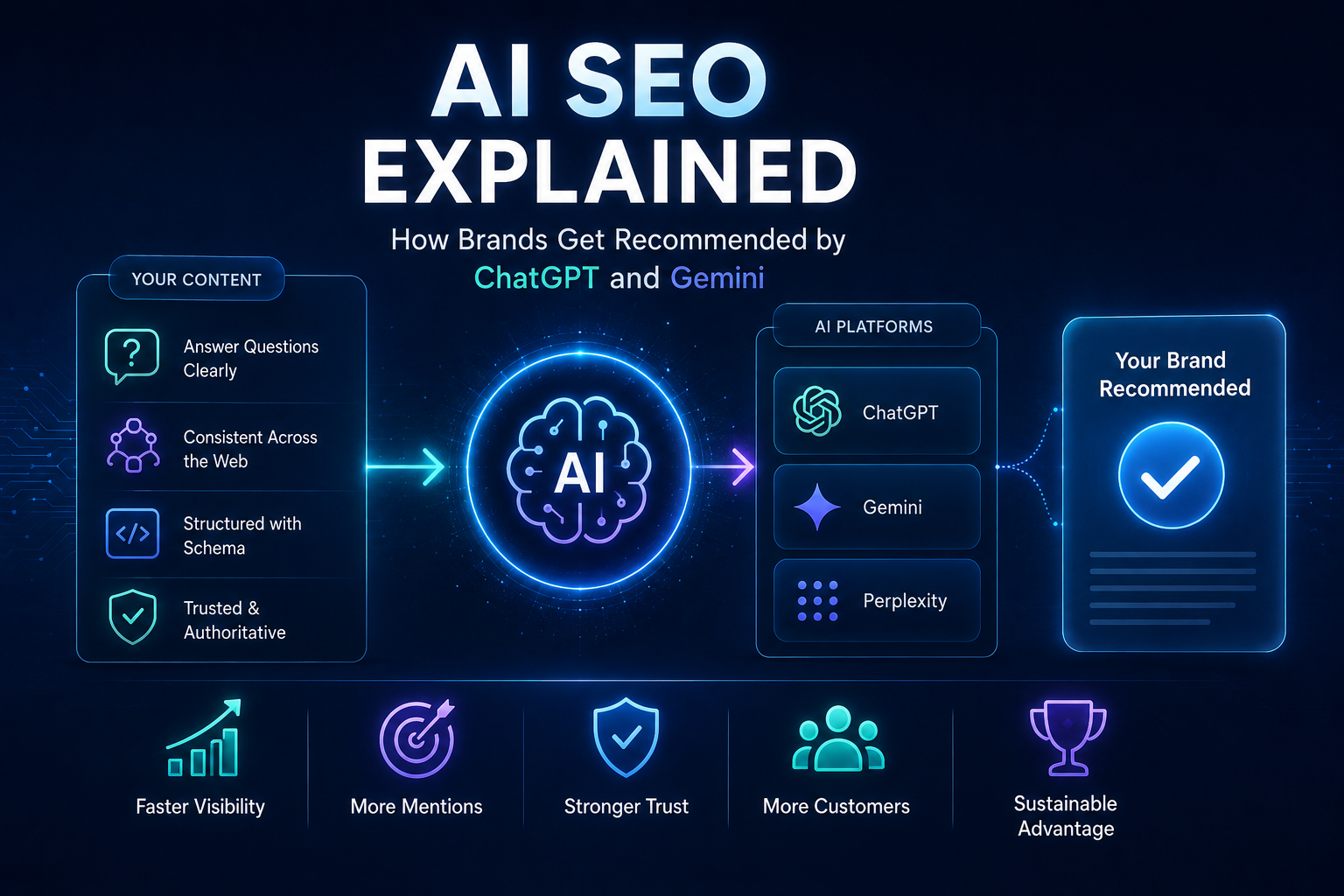
More customers now ask ChatGPT, Perplexity, or Google AI Overviews a direct question and act on whatever answer comes back, often without ever visiting a traditional search results page. Businesses that show up in those answers earn the customer. Businesses that don't, quietly disappear from the conversation, no matter how good their product or service actually is. Following the right AI SEO practices is what separates the two.
Below are ten practices worth building into your strategy this year.
1. Start With an AI Visibility Audit
Before making any changes, find out how often, and how accurately, your brand is currently mentioned across major AI platforms. This baseline tells you exactly where to focus your effort first, instead of guessing where the biggest gaps actually are.
2. Structure Content Around Real Questions
People phrase things conversationally when talking to AI assistants, not the way they type into a search bar. Build content around the exact, natural questions your customers are likely asking, rather than stiff, keyword-heavy phrasing that reads awkwardly to both AI systems and human readers.
3. Add Schema Markup Consistently
Structured data helps AI systems understand exactly what your content is about. Make sure to include:
FAQ schema on pages that directly answer customer questions
Organization schema so your brand details are clearly machine-readable
Product or service schema wherever it applies
4. Keep Your Content Fresh
AI platforms, especially those that browse in real time, tend to favor sources that feel current. Review key pages regularly, update outdated statistics, and add visible last-updated dates where possible.
5. Build Consistent Authority Across the Web
AI models trust information repeated consistently across multiple credible sources more than a single claim made only on your own site. Keep your business details identical across every directory, review platform, and third-party mention, since mismatched details quietly erode trust signals over time.
6. Prioritize Platforms Based on Where Your Customers Are
Not every AI platform works the same way. ChatGPT blends training data with live browsing, Google AI Overviews leans on Google's existing index, and Perplexity favors recent, clearly-sourced content. Focus effort where your specific audience is actually asking questions, rather than spreading resources evenly across every platform.
7. Write Clear, Scannable Answers
Answer the core question within the first sentence or two under each heading, rather than burying it deep in a long paragraph. AI systems extract information more reliably from clearly organized, direct content.
8. Earn Third-Party Mentions, Not Just Backlinks
Traditional backlinks still matter, but AI SEO rewards genuine mentions and citations from credible external sources even more. Guest content, expert quotes, and directory listings all help build this kind of authority, and they tend to carry more weight than links alone.
9. Track Mentions and Citation Accuracy Monthly
Set up a simple routine to check how often your brand appears in AI-generated answers and whether the information is accurate. Catching inaccuracies or drops in visibility early makes them far easier to fix.
10. Treat It as an Ongoing Habit, Not a One-Time Project
AI models update frequently, and competitors keep optimizing too. Visibility that improves this quarter can quietly erode by next quarter without continued attention and regular content refreshes, so this practice needs to sit alongside all the others, not come after them.
Myth vs Reality: What Slows Businesses Down
Myth: "Strong Google rankings automatically mean strong AI visibility." Reality: Search rankings and AI citations rely on different signals, so solid traditional SEO doesn't guarantee your brand gets mentioned by AI tools.
Myth: "AI SEO is just old SEO tactics with a new label." Reality: While some skills overlap, AI SEO requires distinct work, like structuring content specifically for how language models retrieve and cite information.
Myth: "Only large, established brands get recommended by AI tools." Reality: Smaller businesses with clear, well-structured, and consistently authoritative content are often cited more reliably than larger competitors with weaker content structure.
Myth: "Once visibility improves, the work is done." Reality: AI models and competitor content both keep changing, so ongoing monitoring and updates matter just as much as the initial push.
Building These Practices Into a Real Routine
None of these ten practices need to happen all at once. Start with an audit and the most obvious content gaps, then layer in schema, authority building, and monthly tracking over the following months. Businesses that treat AI SEO as a consistent habit, rather than a one-time project, are the ones that keep showing up as more customers rely on AI tools to make decisions, while competitors who treated it as a quick fix quietly fall behind.
Comments
Log in or sign up to join the conversation.